
Muhammad Ichsan Fadillah
Full Article: View PDF
Licence: 
How to cite
Fadillah M.I., Beyond Transparency: How Governance Complexity Shapes Corruption’s Political Consequences, “Polish Journal of Political Science”, 2026, Vol. 12, Issue 1, pp. 22–51, DOI: 10.58183/pjps.02012026.
ABSTRACT
Transparency reforms frequently fail to translate disclosure into political accountability. This paper argues that the missing concept is legibility: the citizen-side capacity to interpret governance information, attribute responsibility, and pursue remediation. Using World Values Survey data from 64 countries, the analysis shows that governance complexity, proxied by city size, is associated with lower corruption perception yet amplified well-being consequences when corruption is perceived. These patterns suggest that transparency fails not because disclosure is unimportant, but because governance complexity undermines citizens’ capacity to act on disclosed information. The findings reframe the policy challenge from increasing disclosure to preserving legibility.
Keywords: transparency, corruption; governance complexity; accountability; well-being
Introduction
Transparency has become a cornerstone of anti-corruption policy worldwide. International organizations, national governments, and civil society groups have invested heavily in disclosure requirements, open data initiatives, and freedom of information legislation, all predicated on the assumption that making governance visible will enable citizens to detect misconduct and hold officials accountable. Yet a growing body of evidence suggests that transparency reforms frequently fail to achieve their intended effects. Catharina Lindstedt and Daniel Naurin demonstrate that simply making information available does not prevent corruption when underlying conditions for publicity and accountability are weak.[1] Sabina Schnell finds that transparency requires citizens to possess not only information but also mechanisms for enacting accountability.[2] Alina Mungiu-Pippidi documents a persistent gap between formal transparency scores and actual corruption outcomes, with many countries maintaining high disclosure standards while corruption remains entrenched.[3] Ivar Kolstad and Arne Wiig conclude that transparency is insufficient in itself and must be complemented by other institutional reforms.[4] Despite widespread recognition that disclosure alone does not reduce corruption or its political consequences, we lack a systematic theoretical account of why transparency so often fails to translate into effective accountability.
This paper proposes that the missing concept is legibility. Drawing on James C. Scott’s foundational work[5] on how states render populations legible for governance purposes, this analysis inverts the concept to ask when governance itself becomes illegible to citizens. Where transparency concerns the government side of the accountability relationship, specifically whether information is disclosed, legibility concerns the citizen side, specifically whether disclosed information can be processed in ways that enable political response. The distinction matters because governance arrangements vary in how readily citizens can interpret information, attribute responsibility to identifiable actors, and pursue remediation when wrongdoing is detected. A government may be formally transparent while corruption remains illegible if citizens cannot trace responsibility through complex institutional structures.
The theoretical argument proceeds in two stages. The first stage concerns how governance complexity reduces corruption salience. As governance scales up and involves more actors, longer principal-agent chains, and fragmented accountability across organizational boundaries, the conditions for legibility deteriorate. Citizens in complex governance systems may have access to disclosed information yet remain unable to identify who is responsible for observed outcomes. Corruption that occurs within such systems is less likely to be recognized as corruption at all; it may appear instead as normal inefficiency, bureaucratic delay, or unattributable market behavior. The empirical implication is that citizens in more complex governance contexts should report lower average corruption perception, not because corruption is objectively less prevalent, but because it is less legible.
The second stage concerns what happens when corruption does become visible in complex governance systems. The argument is that perceived corruption produces amplified harm under conditions of governance complexity because citizens face what can be termed remediation failure. When corruption breaks through the illegibility barrier in a complex system, citizens confront a situation in which they cannot identify responsible actors, lack effective channels for directing complaints, face high costs of disengagement from essential public services, and must contend with uncertainty about what other failures remain hidden. This combination produces not merely frustration but genuine harm to well-being, as citizens experience institutional helplessness in the face of visible wrongdoing. Experimental research by Eleanor Florence Woodhouse, Paolo Belardinelli, Anthony Michael Bertelli provides behavioral evidence that citizens struggle to attribute responsibility in hybrid governance arrangements, lending support to this account of how complexity undermines response capacity.[6] The empirical implication is that the negative association between perceived corruption and well-being should be stronger in more complex governance contexts, reflecting the amplified consequences of remediation failure.
This paper tests these implications using data from the World Values Survey Wave 7, which provides individual-level measures of corruption perceptions and well-being across 64 countries and over 89,000 respondents.[7] City size serves as a proxy for governance complexity, on the theoretical grounds that larger jurisdictions involve more agencies, more delegation, longer accountability chains, and reduced relational governance compared to smaller settlements. The analysis employs ordinary least squares regression with country fixed effects to examine both the direct association between city size and corruption perceptions and the interaction between corruption perceptions and city size in predicting well-being. The findings are consistent with both stages of the theoretical mechanism. Larger cities are associated with lower reported corruption perceptions, and the negative relationship between corruption perceptions and well-being is steeper in larger cities. These patterns align with the proposed account of how governance complexity shapes the legibility and political consequences of corruption.
The contribution of this paper lies in explaining why transparency reforms frequently fail to produce effective political accountability for corruption. The answer proposed here is that governance complexity undermines citizens’ capacity to attribute responsibility and pursue remediation, even when information is disclosed. This reframes the policy challenge from increasing disclosure to preserving legibility, that is, designing governance arrangements that maintain citizens’ capacity to trace responsibility and act on disclosed information. The analysis connects the transparency and accountability literatures by identifying legibility as the citizen-side complement to government-side disclosure, and it contributes to research on corruption and well-being by theorizing institutional moderators of corruption’s political effects. Prior work has shown that the corruption environment moderates the relationship between corruption experiences and well-being,[8] but the mechanisms underlying such moderation have remained underspecified. The legibility framework developed here provides a theoretical account of why context matters for corruption’s consequences.
Several qualifications delimit the scope of the analysis. The paper does not identify causal effects of specific governance instruments, nor does it distinguish among types of corruption. City size serves as a theoretically grounded but admittedly coarse proxy for institutional complexity, and the cross-sectional design precludes causal inference. The contribution lies not in definitive causal identification but in offering a systematic explanation for an established policy puzzle, with empirical patterns that align with the proposed theoretical mechanism.
Theoretical Framework
The Puzzle of Ineffective Transparency
The standard theory underlying transparency reforms follows a straightforward causal logic.[9] When governments disclose information about their operations, citizens gain the ability to detect misconduct. Detection enables accountability, as citizens can sanction wrongdoers through electoral punishment, public pressure, or formal complaint mechanisms. Accountability, in turn, deters future corruption. This causal chain has motivated an expansive global agenda of disclosure requirements, open government initiatives, and freedom of information legislation.
Yet the empirical record suggests persistent failures in this causal chain. Open budget initiatives have shown limited effects on corruption outcomes.[10] Countries participating in the Extractive Industries Transparency Initiative have achieved improvements in disclosure without corresponding reductions in corruption perceptions.[11] Freedom of information laws produce variable results that depend heavily on implementation context.[12] Across multiple policy domains, the pattern repeats: transparency increases, but corruption and its consequences persist.
Existing explanations for these failures tend to focus on scope conditions. Lindstedt and Naurin emphasize that transparency requires complementary conditions, including education, media circulation, and free elections, to become effective.[13] Schnell argues that citizens need not only information but also mechanisms for enacting accountability.[14] Mungiu-Pippidi distinguishes between formal and effective transparency, noting that disclosure requirements may exist on paper without producing real accountability in practice.[15] These contributions identify important boundary conditions, but they leave a theoretical gap. If transparency requires certain conditions to work, what precisely is the mechanism through which those conditions operate? Why does disclosure fail to translate into accountability even when information is technically available?
This paper proposes that the missing element is not another scope condition but a conceptual distinction that has been overlooked in prior theorizing. The distinction is between transparency, understood as government-side disclosure of information, and legibility, understood as citizen-side capacity to process disclosed information in ways that enable political response. Transparency initiatives focus on making information available. Legibility concerns what happens after information becomes available, specifically whether citizens can interpret that information, attribute responsibility to identifiable actors, and pursue remediation when wrongdoing is detected. A governance system can be formally transparent while corruption remains illegible if the institutional structure prevents citizens from tracing responsibility through complex organizational arrangements.
From Transparency to Legibility
The concept of legibility draws on Scott’s influential analysis[16] of how states render populations and territories legible for purposes of governance. Scott argues that modern states engage in simplification and standardization, creating categories, maps, and measurement systems that allow administrators to “see” and manage complex social realities. Legibility in Scott’s account is a state-centric capacity: the ability of governing institutions to read and act upon the populations they govern.
This paper inverts the concept to examine legibility from below. Rather than asking how states make society legible, the question becomes when and how governance itself becomes legible or illegible to citizens. The inversion is not merely rhetorical. It directs attention to a set of conditions that transparency scholarship has largely neglected, namely the cognitive and institutional requirements that enable citizens to make sense of disclosed information and translate it into political action.
Legibility as developed here encompasses four dimensions that can be specified as follows. The first dimension is visibility, which concerns whether corruption can be observed at all. Some forms of corruption occur in settings that citizens cannot access, involve technical complexity that obscures wrongdoing, or take place through informal channels that leave no documentary trace. Transparency reforms address this dimension by requiring disclosure, but visibility alone does not ensure legibility.
The second dimension is interpretability, which concerns whether citizens can recognize observed behavior as corrupt. The boundary between legitimate and illegitimate conduct is not always clear, particularly in contexts where gift-giving, patronage, or informal exchange are culturally embedded practices. Even when citizens observe potentially corrupt behavior, they may lack the cognitive framework to categorize it as corruption rather than normal practice.
The third dimension is attributability, which concerns whether responsibility can be assigned to identifiable actors. This dimension is central to the theoretical argument developed here. Even when corruption is visible and recognized as such, citizens may be unable to determine who is responsible. In simple governance structures with clear hierarchies and direct relationships between citizens and officials, attributability is relatively straightforward. In complex governance structures involving multiple agencies, contractors, and levels of government, responsibility becomes diffuse and difficult to trace.
The fourth dimension is actionability, which concerns whether citizens can pursue remediation once corruption is identified and attributed. Actionability depends on the availability of effective channels for voice, including complaint mechanisms, electoral accountability, media access, and civil society organization. It also depends on the costs of pursuing remediation relative to the expected benefits.
Of these four dimensions, attributability occupies a privileged position in the present analysis. The reason is that attributability is the dimension most directly affected by governance complexity. Transparency reforms can enhance visibility by requiring disclosure. Education and civic awareness campaigns can improve interpretability by clarifying what counts as corruption. Institutional reforms can strengthen actionability by creating complaint mechanisms and protecting whistleblowers. However, attributability depends fundamentally on how governance is organized. When responsibility is fragmented across multiple actors and organizational boundaries, no amount of disclosure can restore clear lines of accountability. Citizens may know that something is wrong without knowing who is responsible, and this uncertainty undermines the entire accountability chain that transparency is meant to activate.
Governance Complexity and Accountability Fragmentation
Governance complexity refers to institutional arrangements characterized by multiple actors with overlapping mandates, extended principal-agent chains, delegation to arm’s-length bodies, hybrid public-private structures, and functional specialization across organizational units. These features have become increasingly prevalent in contemporary governance as states have adopted New Public Management reforms, contracted out service delivery, created independent agencies, and entered into partnerships with private actors.[17]
The accountability implications of governance complexity have received substantial scholarly attention. Mark Bovens, Thomas Schillemans, and Paul T. Hart identify multiple forms of accountability, including political, legal, administrative, and social accountability, noting that these can conflict and create gaps when governance involves multiple principals.[18] Schillemans examines horizontal accountability in agencified systems, finding that accountability relationships become more diffuse as organizations multiply.[19] Seulki Lee and Sonia M. Ospina develop a framework for assessing accountability in collaborative governance, highlighting the challenges that arise when responsibility is shared across organizational boundaries.[20] Anne Stafford and Pamela Stapleton document how hybridity in public-private partnerships creates accountability deficits that neither public nor private accountability regimes adequately address.[21]
The common thread in this literature is that governance complexity fragments accountability. In traditional hierarchical governance, citizens can trace responsibility through clear vertical lines from service delivery to elected officials.[22] In complex governance, these lines become tangled. A citizen who experiences a service failure in a contracted-out arrangement may be unable to determine whether responsibility lies with the contractor, the contracting agency, the regulatory body, or elected officials who authorized the arrangement. John Forrer, James Edwin Kee, Kathryn E. Newcomer, Eric Boyer describe this as the “public accountability question” in public-private partnerships, noting that blurred boundaries between public and private actors obscure who is answerable to whom.[23]
Woodhouse, Belardinelli, Bertelli provide experimental evidence that citizens struggle with attribution in hybrid governance contexts.[24] Their research demonstrates that even when citizens are provided with information about governance arrangements, they have difficulty connecting observed outcomes to responsible actors when multiple organizations are involved. This finding provides a behavioral microfoundation for the theoretical claim that complexity undermines attributability. The problem is not simply that information is unavailable, but that the cognitive task of tracing responsibility through complex institutional webs exceeds ordinary citizens’ capacity.
A potential countervailing consideration warrants acknowledgment. Larger and more institutionally complex governance contexts may also enable the creation of specialized oversight and control bodies, including anti-corruption agencies, independent audit authorities, and ombudsman offices, which could partially offset legibility deficits.[25] These dedicated institutions may serve as intermediaries that conduct attribution on behalf of citizens, simplifying the accountability landscape even within otherwise fragmented systems. However, the effectiveness of such bodies varies considerably across contexts and depends on factors including political independence, adequate resourcing, and enforcement capacity.[26] The present analysis cannot distinguish between complex governance contexts with and without such compensatory institutions, representing a limitation that future research might address through more fine-grained measurement of oversight arrangements.
City size serves in this analysis as a proxy for governance complexity. The theoretical justification is that larger jurisdictions tend to involve more agencies with specialized functions, longer chains of delegation between citizens and decision-makers, greater reliance on contracting and partnership arrangements, and reduced opportunities for the relational governance that characterizes smaller communities. This is not to claim that large cities are uniquely or uniformly complex, nor that small towns are free of governance challenges. The claim is more modest: institutional scale correlates with features that reduce legibility, making city size a reasonable if imperfect proxy for the underlying concept.
The Two-Stage Mechanism
The theoretical framework yields a two-stage mechanism linking governance complexity to corruption’s political consequences. The first stage concerns how complexity reduces corruption salience. When governance involves multiple actors and fragmented accountability, the attributability dimension of legibility is compromised. Citizens cannot easily identify who is responsible for observed problems. Corruption that occurs within such systems is less likely to be perceived as corruption because citizens lack the ability to trace wrongdoing to specific actors. Instead, corrupt outcomes may be interpreted as bureaucratic inefficiency, market behavior, or simply bad luck. The result is lower average corruption perception in more complex governance contexts, not because corruption is objectively less prevalent, but because it is less legible to citizens.
The second stage concerns what happens when corruption does become visible despite governance complexity. The argument is that perceived corruption produces amplified harm under conditions of complexity because citizens face remediation failure. This amplification operates through several channels that can be elaborated as follows.
Firstly, attribution failure persists even when corruption is perceived. Citizens may recognize that corruption exists without being able to identify responsible actors, leaving them unable to direct complaints or sanctions effectively. Secondly, voice failure compounds the problem. Complex governance systems often lack clear channels through which citizens can pursue accountability, and the channels that do exist may be designed for simpler accountability relationships. Thirdly, exit barriers limit alternative responses. Citizens who depend on public services cannot easily disengage when those services are delivered through complex arrangements, leaving them exposed to ongoing harm. Fourthly, uncertainty amplification magnifies the psychological impact. Visible corruption in an opaque system signals that other failures may remain hidden, generating anxiety about the broader institutional environment.
The consequence of remediation failure is that perceived corruption in complex governance systems produces greater harm to well-being than equivalent perception in simpler systems. This is not a claim about psychological sensitivity or emotional reactivity. The mechanism is institutional rather than psychological. Citizens in complex systems face genuine constraints on their ability to respond to perceived corruption, and this institutional helplessness translates into well-being costs. Prior research has shown that the corruption environment moderates the relationship between corruption and well-being,[27] and that institutional quality conditions corruption’s effects.[28] The framework developed here provides a theoretical account of why such moderation occurs: governance complexity shapes the legibility of corruption and thereby conditions its political consequences.
Illustrative Application: Hybrid Governance Arrangements
Public-private partnerships exemplify the dynamics theorized above, though they are not directly measured in the empirical analysis. Partnerships involve multiple principals, including government agencies, private shareholders, and lenders, each with distinct accountability expectations. They operate across public and private accountability regimes, with neither fully applicable.[29] Contractual complexity, often involving long-term agreements with detailed performance specifications, obscures responsibility for service outcomes. When failures occur, citizens cannot easily determine whether the problem lies with the private operator, the government contract manager, the regulatory framework, or the original policy decision to pursue partnership.
Similar dynamics arise in other complex governance forms, including contracted service delivery, arm’s-length agencies, and multi-level governance arrangements. The argument is not that public-private partnerships are uniquely problematic or the dominant source of complexity effects. Rather, partnerships serve as a vivid illustration of how hybrid arrangements fragment accountability and reduce legibility. The theoretical framework applies broadly to governance complexity regardless of its specific institutional source.
Hypotheses
The theoretical framework developed above yields two testable hypotheses corresponding to the two stages of the proposed mechanism. The first hypothesis concerns how governance complexity affects corruption salience, while the second concerns how complexity conditions the relationship between perceived corruption and well-being.
Hypothesis 1: Governance complexity is negatively associated with perceived corruption.
The first hypothesis derives from Stage 1 of the mechanism, which holds that governance complexity reduces the legibility of corruption by fragmenting accountability across multiple actors and organizational boundaries. When citizens cannot easily attribute responsibility for observed problems, they are less likely to categorize those problems as corruption. Instead, corrupt outcomes may be interpreted as bureaucratic inefficiency, market dynamics, or unattributable misfortune. The empirical implication is that citizens in more complex governance contexts should report lower average corruption perception, not because corruption is objectively less prevalent, but because it is less legible.
Hypothesis 2: The negative association between perceived corruption and well-being is stronger under conditions of greater governance complexity.
The second hypothesis derives from Stage 2 of the mechanism, which holds that perceived corruption produces amplified harm under conditions of governance complexity due to remediation failure. When corruption does become visible in complex systems, citizens confront a situation in which they cannot identify responsible actors, lack effective channels for pursuing accountability, face barriers to disengagement from essential services, and must contend with uncertainty about what other failures remain hidden. This combination produces institutional helplessness that translates into well-being costs beyond those experienced by citizens who perceive equivalent corruption in simpler governance contexts. Prior research has demonstrated that contextual factors moderate the relationship between corruption and well-being,[30] but the mechanisms underlying such moderation have remained underspecified. The legibility framework provides a theoretical account of why governance context should condition corruption’s consequences.
It bears emphasis that Hypothesis 2 concerns conditional effects rather than average levels. The claim is not that citizens in complex governance systems experience lower well-being overall, but that the marginal impact of perceived corruption on well-being is steeper when governance complexity is higher. This distinction matters for interpreting the empirical results that follow.
Data and Methods
Data Source
The empirical analysis draws on the World Values Survey Wave 7, which was conducted between 2017 and 2022 across 64 countries and territories.[31] The World Values Survey is a global research project that explores values, beliefs, and attitudes across societies, providing standardized measures that enable cross-national comparison. Wave 7 includes 89,009 respondents after listwise deletion of cases with missing values on the variables used in this analysis. The sample encompasses considerable diversity in governance contexts, economic development levels, and cultural settings, ranging from established democracies with strong institutional frameworks to countries experiencing significant governance challenges.
The World Values Survey is particularly suited to this analysis for several reasons. Firstly, it provides individual-level data on both corruption perceptions and well-being, allowing for an examination of how these relate within individuals rather than relying solely on country-level aggregates. Secondly, the survey includes a measure of community size that can serve as a proxy for governance complexity, enabling within-country variation in the key moderating variable. Thirdly, the cross-national scope permits testing whether the proposed patterns hold across diverse institutional and cultural contexts, strengthening confidence that the findings reflect general dynamics rather than idiosyncratic features of particular settings.
Variables and Measurement
The dependent variable in the primary analysis is well-being, measured using the World Values Survey happiness item. Respondents were asked to indicate how happy they are, with responses recorded on a four-point scale ranging from 1, indicating not at all happy, to 4, indicating very happy. This item is widely used in well-being research and has demonstrated validity across cultural contexts.[32] While ordinal in nature, the item is commonly treated as continuous in regression analysis, and this approach is followed here.[33] Alternative specifications using life satisfaction as the dependent variable yield substantively similar results.
The key independent variable is corruption perception, measured by asking respondents how widespread they think corruption is in their country’s government. Responses are recorded on a four-point scale where higher values indicate greater perceived corruption. This measure captures the subjective salience of corruption rather than objective corruption levels, which is appropriate for the theoretical framework developed here. The argument concerns when corruption becomes visible and consequential to citizens, not whether corruption objectively exists. Perception-based measures are standard in research on corruption’s political and psychological effects.[34]
The moderating variable is governance complexity, operationalized through city size. The World Values Survey records community size in eight categories ranging from settlements under 2,000 inhabitants to cities of 500,000 or more. The theoretical justification for this proxy, developed in the preceding section, holds that larger jurisdictions tend to involve more governmental agencies with specialized functions, longer chains of delegation between citizens and ultimate decision-makers, greater prevalence of contracting and partnership arrangements for service delivery, and reduced opportunities for the relational governance that characterizes smaller communities where repeated personal interactions facilitate informal accountability.
City size is admittedly a coarse proxy for governance complexity. It does not isolate specific mechanisms such as the number of agencies, the depth of contracting, or the prevalence of hybrid arrangements. It captures institutional scale effects without distinguishing among the particular features that may drive those effects. The claim is not that city size perfectly measures governance complexity, but that it correlates sufficiently with the underlying concept to permit a meaningful empirical test. Ideal measurement would involve direct indicators of governance arrangements at the local level, but such data are not available in cross-national surveys. The analysis proceeds with city size as a theoretically grounded if imperfect operationalization, and the interpretation of results accounts for this limitation.
Two clarifications regarding this operationalization merit emphasis. First, the smallest population categories in the World Values Survey classification, particularly settlements under 2,000 inhabitants, may be closer to rural or small-scale settings than to urban contexts in a strict definitional sense. Second, and relatedly, city size is employed here as a proxy for institutional scale and governance complexity rather than as a substantive urban-rural distinction. The theoretical mechanism concerns the fragmentation of accountability and the length of principal-agent chains, which correlate with settlement size regardless of whether a given community meets formal criteria for urban classification. The analysis thus treats community size as a scalar indicator of governance complexity rather than a categorical marker of urbanity.
The analysis includes several control variables to address potential confounding. Age is measured in years and accounts for life-cycle effects on both corruption perception and well-being. Gender is coded as a binary variable. Education is measured using the World Values Survey’s nine-category scale reflecting the highest completed educational level. Income is measured using a ten-point scale on which respondents place their household’s income relative to others in their country. These sociodemographic controls are standard in research on corruption perception and well-being.[35]
Empirical Strategy
The analysis proceeds in two stages corresponding to the two hypotheses. The first model tests Hypothesis 1 by regressing corruption perception on city size and control variables. The specification takes the following form, where corruption perception for each individual in a given country is modeled as a function of city size, individual-level controls, and country fixed effects. Model 1: Corruption Perception = β₀ + β₁(City Size) + β₂(Controls) + Country Fixed Effects + ε. The coefficient captures the association between city size and corruption perception. Hypothesis 1 predicts a negative coefficient, indicating that residents of larger cities report lower corruption perception on average.
The second model tests Hypothesis 2 by regressing well-being on corruption perception, city size, their interaction, and control variables. The specification takes the following form. Model 2: Well-being = β₀ + β₁(Corruption) + β₂(City Size) + β₃(Corruption × City Size) + β₄(Controls) + Country Fixed Effects + ε. The key coefficient is β₃, which captures how the relationship between corruption perception and well-being varies with city size. Hypothesis 2 predicts a negative interaction coefficient, indicating that the negative association between perceived corruption and well-being is steeper in larger cities where governance complexity is greater.
Both models include country fixed effects, which absorb unobserved country-level heterogeneity, including differences in actual corruption levels, institutional quality, cultural factors affecting response patterns, and economic conditions. This approach ensures that estimates reflect within-country variation rather than cross-country differences that might confound interpretation. Standard errors are clustered at the country level to account for potential correlation of residuals within countries.
Limitations
Several limitations warrant acknowledgment before presenting results. The cross-sectional design precludes causal inference. The observed associations may reflect reverse causality, as citizens with lower well-being might perceive more corruption, or omitted variables that jointly influence corruption perception, well-being, and residential location. City size as a proxy does not isolate specific governance mechanisms. Self-reported measures of both corruption perception and well-being are subject to various response biases. The analysis cannot distinguish among types of corruption or identify effects of specific governance instruments such as public-private partnerships. These limitations are addressed not through methodological solutions, which are unavailable given the data, but through interpretive caution. The contribution lies in identifying patterns consistent with the theoretical framework rather than establishing definitive causal effects.
Results
Descriptive Patterns
The sample encompasses considerable variation in both governance contexts and individual characteristics. Table 1 presents the distribution of respondents across urban categories and countries, illustrating the global scope of the analysis. The sample includes respondents from 64 countries spanning diverse regions, economic development levels, and institutional arrangements. Urban categories range from small settlements under 2,000 inhabitants to major cities exceeding 500,000, with representation across the full spectrum of community sizes.
Table 1. Global distribution of urban governance contexts
|
Country / |
Under 2,000 |
2,000-5,000 |
5-10,000 |
10-20,000 |
20-50,000 |
50-100,000 |
100-500,000 |
500,000 and more |
Total |
|
Andorra |
55 |
106 |
319 |
214 |
267 |
0 |
0 |
0 |
961 |
|
Argentina |
71 |
39 |
33 |
38 |
38 |
56 |
70 |
558 |
903 |
|
Armenia |
205 |
108 |
107 |
81 |
135 |
0 |
76 |
419 |
1131 |
|
Australia |
90 |
98 |
137 |
119 |
171 |
137 |
251 |
695 |
1698 |
|
Bangladesh |
165 |
317 |
320 |
150 |
149 |
44 |
12 |
0 |
1157 |
|
Bolivia |
393 |
30 |
101 |
65 |
245 |
105 |
365 |
691 |
1995 |
|
Brazil |
43 |
45 |
49 |
40 |
119 |
225 |
486 |
691 |
1698 |
|
Canada |
305 |
261 |
249 |
283 |
373 |
446 |
875 |
1226 |
4018 |
|
Chile |
114 |
12 |
0 |
12 |
29 |
108 |
342 |
346 |
963 |
|
China |
0 |
0 |
0 |
48 |
604 |
1306 |
1032 |
0 |
2990 |
|
Colombia |
16 |
48 |
128 |
112 |
176 |
210 |
336 |
494 |
1520 |
|
Cyprus |
120 |
217 |
201 |
23 |
38 |
42 |
294 |
0 |
935 |
|
Czechia |
283 |
162 |
107 |
106 |
171 |
64 |
117 |
142 |
1152 |
|
Germany |
47 |
165 |
0 |
455 |
252 |
85 |
250 |
194 |
1448 |
|
Ecuador |
40 |
118 |
118 |
97 |
121 |
56 |
273 |
341 |
1164 |
|
Ethiopia |
87 |
98 |
338 |
278 |
191 |
156 |
22 |
9 |
1179 |
|
G. Britain |
18 |
94 |
92 |
279 |
481 |
402 |
770 |
376 |
2512 |
|
Greece |
271 |
29 |
50 |
46 |
145 |
138 |
45 |
434 |
1158 |
|
Guatemala |
0 |
1 |
12 |
58 |
167 |
142 |
183 |
645 |
1208 |
|
Hong Kong |
0 |
0 |
0 |
0 |
0 |
0 |
0 |
2030 |
2030 |
|
Indonesia |
587 |
822 |
781 |
520 |
255 |
65 |
20 |
92 |
3142 |
|
India |
759 |
379 |
171 |
50 |
58 |
110 |
57 |
42 |
1626 |
|
Iran |
29 |
118 |
136 |
108 |
191 |
136 |
255 |
464 |
1437 |
|
Iraq |
0 |
74 |
66 |
170 |
33 |
0 |
189 |
621 |
1153 |
|
Jordan |
53 |
136 |
101 |
32 |
85 |
86 |
90 |
436 |
1019 |
|
Japan |
0 |
4 |
2 |
36 |
87 |
144 |
393 |
421 |
1087 |
|
Kazakhstan |
81 |
92 |
80 |
113 |
57 |
43 |
225 |
283 |
974 |
|
Kenya |
116 |
171 |
88 |
99 |
100 |
123 |
185 |
120 |
1002 |
|
Kyrgyzstan |
94 |
324 |
141 |
86 |
103 |
82 |
76 |
197 |
1103 |
|
S. Korea |
0 |
0 |
0 |
0 |
0 |
102 |
262 |
881 |
1245 |
|
Lebanon |
30 |
55 |
194 |
128 |
379 |
178 |
100 |
130 |
1194 |
|
Libya |
69 |
161 |
65 |
154 |
137 |
200 |
186 |
121 |
1093 |
|
Macao |
0 |
0 |
0 |
0 |
0 |
0 |
0 |
1014 |
1014 |
|
Morocco |
60 |
90 |
110 |
120 |
140 |
80 |
260 |
340 |
1200 |
|
Maldives |
488 |
118 |
80 |
44 |
57 |
0 |
241 |
0 |
1028 |
|
Mexico |
254 |
242 |
197 |
151 |
77 |
119 |
265 |
402 |
1707 |
|
Myanmar |
192 |
456 |
240 |
228 |
84 |
0 |
0 |
0 |
1200 |
|
Mongolia |
95 |
220 |
63 |
0 |
197 |
0 |
60 |
1003 |
1638 |
|
Malaysia |
133 |
288 |
159 |
164 |
157 |
146 |
125 |
141 |
1313 |
|
Nigeria |
137 |
312 |
176 |
214 |
127 |
107 |
137 |
13 |
1223 |
|
Nicaragua |
0 |
20 |
190 |
171 |
339 |
220 |
150 |
110 |
1200 |
|
N. Ireland |
0 |
19 |
20 |
0 |
118 |
141 |
135 |
0 |
433 |
|
Netherlands |
0 |
2 |
7 |
71 |
535 |
382 |
513 |
167 |
1677 |
|
N. Zealand |
136 |
0 |
107 |
88 |
73 |
74 |
165 |
156 |
799 |
|
Pakistan |
264 |
568 |
315 |
20 |
55 |
7 |
162 |
435 |
1826 |
|
Peru |
287 |
34 |
10 |
20 |
119 |
241 |
578 |
100 |
1389 |
|
Philippines |
347 |
260 |
209 |
90 |
230 |
60 |
0 |
0 |
1196 |
|
Puerto Rico |
0 |
0 |
0 |
73 |
645 |
258 |
137 |
0 |
1113 |
|
Romania |
55 |
281 |
161 |
111 |
87 |
96 |
204 |
116 |
1111 |
|
Russia |
302 |
52 |
75 |
100 |
144 |
103 |
307 |
529 |
1612 |
|
Singapore |
0 |
0 |
0 |
0 |
0 |
0 |
0 |
1926 |
1926 |
|
Serbia |
95 |
55 |
189 |
38 |
102 |
137 |
191 |
146 |
953 |
|
Slovakia |
347 |
169 |
94 |
104 |
167 |
116 |
149 |
0 |
1146 |
|
Thailand |
902 |
134 |
116 |
61 |
75 |
25 |
14 |
130 |
1457 |
|
Tunisia |
48 |
257 |
116 |
70 |
163 |
238 |
187 |
80 |
1159 |
|
Turkiye |
78 |
12 |
79 |
37 |
249 |
203 |
1178 |
386 |
2222 |
|
Taiwan |
0 |
0 |
0 |
38 |
195 |
344 |
567 |
18 |
1162 |
|
Ukraine |
350 |
108 |
54 |
58 |
61 |
76 |
193 |
273 |
1173 |
|
Uruguay |
47 |
34 |
77 |
80 |
125 |
98 |
28 |
410 |
899 |
|
USA |
0 |
0 |
0 |
0 |
630 |
237 |
559 |
380 |
1806 |
|
Uzbekistan |
0 |
0 |
0 |
0 |
0 |
0 |
0 |
1077 |
1077 |
|
Venezuela |
10 |
60 |
30 |
80 |
120 |
98 |
437 |
348 |
1183 |
|
Vietnam |
0 |
0 |
0 |
0 |
0 |
89 |
881 |
132 |
1102 |
|
Zimbabwe |
284 |
461 |
147 |
24 |
83 |
114 |
57 |
0 |
1170 |
|
Total |
9052 |
8536 |
7207 |
6255 |
10511 |
8800 |
15717 |
22931 |
89009 |
Source: Author’s analysis of World Values Survey Wave 7 data.
Corruption perception varies substantially both across and within countries. The mean corruption perception score is 2.89 on the four-point scale, indicating that respondents on average perceive corruption as fairly widespread in their national governments. Well-being shows a mean of 3.05 on the four-point scale, suggesting that most respondents report being relatively happy. The correlation between corruption perception and well-being is negative, as expected from prior literature, though modest in magnitude.
Regression Results
Table 2 presents the full regression results for both models. Model 1 tests Hypothesis 1 by regressing corruption perception on city size and controls. Model 2 tests Hypothesis 2 by regressing well-being on corruption perception, city size, their interaction, and controls. Both models include country fixed effects and cluster standard errors at the country level.
Table 2. Regression results: Corruption perception and well-being[36]
|
Variable |
Model 1: Corruption Perception |
Model 2: Well-being |
|
City Size |
−0.014*** (0.002) |
−0.003 (0.002) |
|
Corruption Perception |
— |
−0.033*** (0.005) |
|
Corruption × City Size |
— |
−0.003*** (0.001) |
|
Age |
−0.002*** (0.000) |
−0.001** (0.000) |
|
Gender (Female) |
0.021** (0.008) |
0.012 (0.007) |
|
Education |
−0.008*** (0.002) |
0.015*** (0.002) |
|
Income |
−0.012*** (0.002) |
0.042*** (0.003) |
|
Constant |
3.142*** (0.031) |
3.285*** (0.024) |
|
Country Fixed Effects |
Yes |
Yes |
|
Observations |
89,009 |
89,009 |
|
R² |
0.0016 |
0.089 |
Source: Own study.
City Size and Corruption Perception
Model 1 tests Hypothesis 1 by examining the association between city size and corruption perception. The results indicate a statistically significant negative relationship. The coefficient on city size is −0.014 with a standard error of 0.002, significant at the p < 0.001 level. This indicates that residents of larger cities report lower corruption perception on average compared to residents of smaller communities, controlling for individual sociodemographic characteristics and country fixed effects. The control variables behave as expected: older respondents, more educated respondents, and higher-income respondents report lower corruption perception, while female respondents report slightly higher perception.
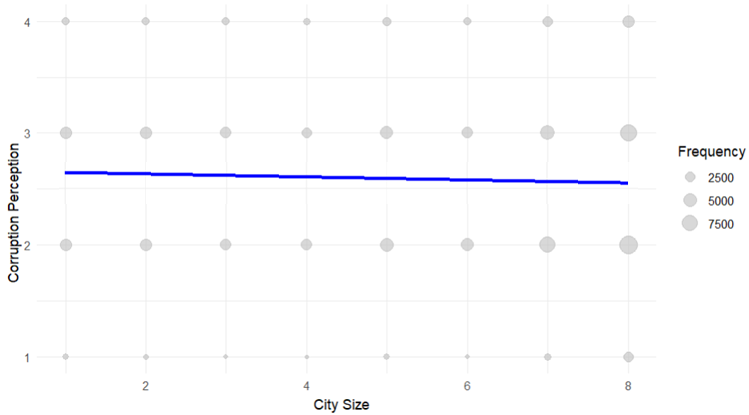
Figure 1 visualizes this relationship through both the regression line and the underlying distribution of observations. The fitted line indicates a negative gradient across the urban hierarchy, with corruption perception declining as city size increases. However, the scatter of individual observations around this line reveals substantial heterogeneity. The coefficient of determination is notably low at R² = 0.0016, indicating that city size explains only a small fraction of the total variation in corruption perception.
Figure 1. The relationship between city size and corruption perception[37]
Source: Author’s analysis of World Values Survey Wave 7 data.
The low explanatory power warrants careful interpretation rather than dismissal. City size is a distal institutional variable predicting individual attitudes that are shaped by numerous proximate factors including personal experiences, media exposure, social networks, and psychological dispositions. The theoretical contribution does not depend on explaining large shares of variance but on identifying a consistent pattern that aligns with the proposed mechanism. The finding that corruption perception is systematically lower in larger cities, even after controlling for individual characteristics and country-level heterogeneity, is consistent with Stage 1 of the theoretical framework. Governance complexity appears to reduce the salience of corruption, not because corruption is objectively less prevalent in larger jurisdictions, but because fragmented accountability renders it less legible to citizens.
The Interaction Between Corruption and City Size
The second model tests Hypothesis 2 by examining whether city size moderates the relationship between corruption perception and well-being. The results support the hypothesis. The coefficient on corruption perception is −0.033, significant at p < 0.001, indicating that perceived corruption is negatively associated with well-being as expected from prior research. The coefficient on city size is −0.003 and does not reach statistical significance, suggesting no direct effect of city size on well-being independent of its moderating role. The crucial coefficient is the interaction term between corruption perception and city size, which is −0.003 and statistically significant at p < 0.001.
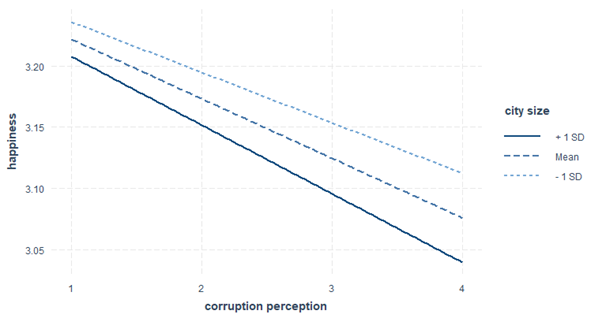
The negative interaction indicates that the relationship between corruption perception and well-being varies systematically with city size. Specifically, the negative association between perceived corruption and well-being is steeper in larger cities than in smaller communities. Among residents of the smallest settlements, perceiving corruption is associated with a relatively modest decline in well-being. Among residents of the largest cities, the same perception is associated with a substantially larger decline.
Figure 2 presents the interaction effect in standardized form, showing the marginal effect of corruption perception on well-being at different levels of city size. At one standard deviation below the mean of city size, representing smaller communities, the effect of corruption perception on well-being is negative but relatively shallow. At one standard deviation above the mean, representing larger cities, the effect is substantially steeper. This visualization crystallizes the central empirical finding: among citizens who perceive corruption, those residing in larger cities experience more pronounced well-being consequences.
Figure 2. Standardized interaction effects showing the marginal impact of corruption perception on well-being at different levels of city size
Source: Author’s analysis of World Values Survey Wave 7 data.
Interpretation and Scope of Findings
The results are consistent with both hypotheses derived from the theoretical framework. Larger cities are associated with lower corruption perception, and the negative relationship between corruption perception and well-being is stronger in larger cities. These patterns align with the two-stage mechanism proposed: governance complexity reduces corruption salience while amplifying the consequences when corruption does become visible.
However, the results carry important limitations that bear on interpretation. Firstly, the cross-sectional design cannot establish causation. The associations observed may reflect reverse causality, wherein citizens with lower well-being perceive more corruption, or omitted variables that jointly influence corruption perception, well-being, and residential location. Secondly, the low explanatory power in Model 1 indicates that city size captures only a small portion of variation in corruption perception. Many other factors shape whether citizens perceive corruption, and city size is at best a partial proxy for the governance complexity mechanism theorized. Thirdly, the analysis cannot identify which specific features of governance complexity drive the observed patterns. Whether the effects operate through agency fragmentation, contracting arrangements, principal-agent chain length, or other mechanisms remains undetermined. Fourthly, the interaction effect, while statistically significant, is modest in magnitude. The substantive impact of the moderation should not be overstated.
What the results do establish is that empirical patterns in a large cross-national dataset are consistent with the theoretical account developed in this paper. The transparency puzzle, wherein disclosure fails to translate into accountability, finds a potential explanation in the concept of legibility. Governance complexity appears to shape both whether citizens perceive corruption and how that perception affects their well-being. These findings do not prove the theory but provide evidence that the proposed mechanism deserves further investigation with research designs better suited to causal identification.
Discussion
Explaining the Transparency Puzzle
This paper began with a puzzle drawn from prior literature: Why do transparency reforms so frequently fail to translate disclosure into political accountability? Studies have documented that open budget initiatives, freedom of information laws, and extractive industry disclosure requirements often produce disappointing results, with corruption perceptions and outcomes remaining stubbornly unchanged despite increased information availability.[38] Existing explanations have pointed to scope conditions such as media freedom, electoral competition, and citizen education, but have not provided a systematic theoretical account of the mechanism through which these conditions operate.[39]
The explanation proposed here centers on the distinction between transparency and legibility. Transparency concerns the government side of the accountability relationship, specifically whether information is disclosed. Legibility concerns the citizen side, specifically whether disclosed information can be processed in ways that enable political response. The findings are consistent with this framework. Governance complexity, proxied by city size, is associated with lower corruption perception, suggesting that fragmented accountability reduces the salience of corruption even when information may be formally available. At the same time, perceived corruption is associated with steeper well-being costs in more complex governance contexts, suggesting that citizens who do perceive corruption face remediation failure when they cannot identify responsible actors or pursue effective accountability.
The transparency puzzle is thus resolved once we recognize that disclosure is a supply-side intervention in an accountability process that also requires demand-side capacity. Governance complexity undermines this demand-side capacity by fragmenting responsibility across multiple actors and organizational boundaries. Citizens may have access to information yet remain unable to trace accountability through complex institutional arrangements. The result is that transparency reforms fail not because disclosure is unimportant, but because disclosure alone cannot overcome the legibility deficits created by contemporary governance structures.
Theoretical Implications
The findings carry several implications for scholarship on governance, accountability, and corruption. First, the concept of legibility offers a theoretical bridge between the transparency literature and research on accountability. Prior work has recognized that transparency and accountability are distinct phenomena, but the mechanisms linking them have remained underspecified.[40] Legibility identifies the citizen-side processing capacity that mediates between disclosed information and accountability outcomes. This suggests that future research on transparency should attend not only to what information is disclosed but also to whether governance arrangements enable citizens to interpret, attribute, and act on that information.
Secondly, the findings contribute to research on institutional moderators of corruption’s effects. Prior studies have demonstrated that corruption environment and institutional quality condition the relationship between corruption and well-being,[41] but the mechanisms underlying such moderation have remained unclear. The legibility framework provides a theoretical account: governance complexity shapes citizens’ capacity to respond to perceived corruption, and this response capacity determines whether corruption produces manageable frustration or deeper harm. The interaction effect observed in this study reflects not psychological differences across urban contexts but institutional differences in remediation possibilities.
Thirdly, the analysis extends scholarship on accountability in complex governance arrangements. Research on public-private partnerships, agencification, and collaborative governance has documented accountability challenges in hybrid and networked structures.[42] The present study connects these governance-level analyses to individual-level consequences, showing that accountability fragmentation matters not only for institutional performance but for citizen well-being. The experimental finding by Woodhouse, Belardinelli, Bertelli that citizens struggle to attribute responsibility in hybrid governance receives indirect support from the patterns observed here, and suggests that attribution failure has downstream consequences for how citizens experience governance outcomes.[43]
Policy Implications
The analysis suggests that the policy challenge is not simply to increase transparency but to preserve legibility in governance design. Several implications follow for practitioners and policymakers concerned with corruption and accountability.
Firstly, transparency reforms should be evaluated not only by whether information is disclosed but by whether disclosed information enables citizen response. This might involve what could be termed legibility audits, assessments of whether governance arrangements allow citizens to identify responsible actors when problems occur. Disclosure requirements that produce voluminous documentation without clear attribution may satisfy formal transparency criteria while failing to enhance actual accountability.
Secondly, governance reforms that introduce complexity should consider accountability implications alongside efficiency gains. Delegation to arm’s-length agencies, contracting with private providers, and creation of partnership arrangements may offer administrative advantages, but they also fragment accountability in ways that reduce citizen capacity for oversight. This is not an argument against such arrangements categorically, but a caution that accountability mechanisms require explicit design attention when governance structures become more complex. Single points of accountability, even if nominal, may help preserve legibility in otherwise fragmented systems.
Thirdly, anti-corruption strategy might shift emphasis from disclosure toward attribution. If the problem is not that citizens lack information but that they cannot trace responsibility, then interventions should focus on clarifying accountability relationships rather than simply increasing information flow. This might include public communication about who is responsible for what, simplified accountability structures for citizen-facing services, and remediation channels that do not require citizens to navigate complex institutional landscapes.
Fourthly, the findings suggest attention to the distribution of governance complexity across populations. If citizens in more complex governance contexts experience amplified harm from perceived corruption, then institutional design choices have equity implications. Communities served by fragmented governance arrangements may bear disproportionate costs when corruption occurs, even if objective corruption levels do not differ.
Future Research
The analysis faces limitations that circumscribe the conclusions that can be drawn and point toward directions for future research. The cross-sectional design cannot establish causation, and the associations observed may reflect selection, reverse causality, or omitted variables. Citizens with lower well-being may be more likely to perceive corruption, or unobserved factors may jointly determine corruption perception, well-being, and residential location. Future research employing panel data, natural experiments, or instrumental variable strategies could provide stronger causal evidence for the proposed mechanism.
The measurement of governance complexity through city size is admittedly coarse. City size correlates with institutional scale but does not isolate specific features such as agency count, contracting prevalence, or principal-agent chain length. Future research with direct measures of governance arrangements at the local level could identify which dimensions of complexity most strongly affect legibility. Administrative data on municipal governance structures, merged with individual-level survey data, would enable more precise tests of the theoretical mechanism.
The analysis cannot distinguish among types of corruption or identify effects of specific governance instruments. Whether the patterns observed apply equally to grand and petty corruption, to corruption in service delivery versus regulatory contexts, or to particular institutional forms such as public-private partnerships remains unknown. Disaggregated analyses focusing on specific governance arrangements and corruption types would strengthen understanding of when and how legibility deficits arise.
Finally, the mechanism itself remains unobserved. The analysis tests implications of the legibility framework rather than directly measuring attribution capacity or remediation attempts. Survey experiments manipulating information about governance complexity and measuring attribution accuracy could provide more direct evidence. Qualitative research exploring how citizens actually attempt to pursue accountability when they perceive corruption would illuminate the remediation failure mechanism proposed here.
Conclusion
Transparency reforms rest on the assumption that disclosed information enables citizens to hold governments accountable. This paper has argued that this assumption overlooks a crucial intermediary: citizens must be able to process disclosed information in ways that permit attribution and response. The concept of legibility captures this citizen-side capacity, and governance complexity systematically undermines it.
The empirical patterns observed in World Values Survey data align with this account. Citizens in larger, more complex governance contexts perceive less corruption yet experience greater harm when corruption becomes visible. These findings do not establish causation, but they suggest that the transparency puzzle may be a legibility puzzle. The challenge for governance reform is therefore not merely to make governments more transparent, but to preserve citizens’ capacity to read them.
Whether through institutional design that maintains clear accountability lines, remediation channels that do not require navigating fragmented structures, or transparency reforms evaluated by their effects on citizen response capacity rather than information volume alone, the path forward requires attention to legibility as the missing link between disclosure and accountability.
References
[1] C. Lindstedt, D. Naurin, Transparency is not enough: Making transparency effective in reducing corruption, “International Political Science Review”, 2010, Vol. 31, Issue 3, pp. 301–322, DOI: 10.1177/0192512110377602.
[2] S. Schnell, To know is to act? Revisiting the impact of government transparency on corruption, “Public Administration and Development”, 2023, Vol. 43, Issue 5, pp. 355–367, DOI: 10.1002/pad.2029.
[3] A. Mungiu-Pippidi, Transparency and corruption: Measuring real transparency by a new index, “Regulation & Governance”, 2023, Vol. 17, Issue 4, pp. 1094–1113, DOI: 10.1111/rego.12416.
[4] I. Kolstad, A. Wiig, Is transparency the key to reducing corruption in resource-rich countries?, “World Development”, 2009, Vol. 37, Issue 3, pp. 521–532, DOI: 10.1016/j.worlddev.2008.07.002.
[5] J.C. Scott, Seeing like a state: How certain schemes to improve the human condition have failed, Yale University Press 1998.
[6] E.F. Woodhouse, P. Belardinelli, A.M. Bertelli, Hybrid Governance and the Attribution of Political Responsibility: Experimental Evidence from the United States, “Journal of Public Administration Research and Theory”, 2022, Vol. 32, Issue 1, pp. 150–165, DOI: 10.1093/jopart/muab014.
[7] C. Haerpfer, et al. (eds.), World Values Survey: Round Seven – Country-Pooled Datafile Version 5.0, JD Systems Institute & WVSA Secretariat 2022, DOI: 10.14281/18241.20.
[8] Y. Wu, J. Zhu, When are people unhappy? Corruption experience, environment, and life satisfaction in mainland China, “Journal of Happiness Studies”, 2016, Vol. 17, pp. 1125–1147, DOI: 10.1007/s10902-015-9635-7.
[9] J. Fox, The uncertain relationship between transparency and accountability, “Development in Practice”, 2007, Vol. 17, Issue 4-5, pp. 663–671, DOI: 10.1080/09614520701469955.
[10] P. de Renzio, J. Wehner, The Impacts of Fiscal Openness, “The World Bank Research Observer”, 2017, Vol. 32, Issue 2, pp. 185–210, DOI: 10.1093/wbro/lkx004; I. Kolstad, A. Wiig, Is transparency the…, op. cit., pp. 521–532.
[11] I. López-Cazar, E. Papyrakis, L. Pellegrini, The extractive industries transparency initiative (EITI) and corruption in Latin America: Evidence from Colombia, Guatemala, Honduras, Peru, and Trinidad and Tobago, “Resources Policy”, 2021, Vol. 70, pp. 1–24, DOI: 10.1016/j.resourpol.2020.101907.
[12] K.Ch. Vadlamannati, A. Cooray, Transparency pays? Evaluating the effects of the freedom of information laws on perceived government corruption, “Journal of Development Studies”, 2017, Vol. 53, Issue 1, pp. 116–137, DOI: 10.1080/00220388.2016.1178385.
[13] C. Lindstedt, D. Naurin, Transparency is not enough…, op. cit., pp. 301–322.
[14] S. Schnell, To know is to act?…, op. cit., pp. 355–367.
[15] A. Mungiu-Pippidi, Transparency and corruption…, op. cit., pp. 1094–1113.
[16] J.C. Scott, Seeing like a state…, op. cit.
[17] C. Skelcher, Public–Private Partnerships and Hybridity, in: The Oxford Handbook of Public Management, eds. E. Ferlie, L.E. Lynn, Ch. Pollitt, Oxford University Press 2007, pp. 347–370; Ch. Hood, A public management for all seasons?, “Public Administration”, 1991, Vol. 69, Issue 1, pp. 3–19, DOI: 10.1111/j.1467-9299.1991.tb00779.x.
[18] M. Bovens, T. Schillemans, P. Hart, Does public accountability work? An assessment tool, “Public Administration”, 2008, Vol. 86, Issue 1, pp. 225–242, DOI: 10.1111/j.1467-9299.2008.00716.x.
[19] T. Schillemans, Accountability in the shadow of hierarchy: The horizontal accountability of agencies, “Public Organization Review”, 2008, Vol. 8, pp. 175–194, DOI: 10.1007/s11115-008-0053-8.
[20] S. Lee, S.M. Ospina, A Framework for Assessing Accountability in Collaborative Governance: A Process-Based Approach, “Perspectives on Public Management and Governance”, 2022, Vol. 5, Issue 1, pp. 63–75, DOI: 10.1093/ppmgov/gvab031.
[21] A. Stafford, P. Stapleton, The impact of hybridity on PPP governance and related accountability mechanisms: the case of UK education PPPs, “Accounting, Auditing & Accountability Journal”, 2022, Vol. 35, Issue 3, pp. 950–980, DOI: 10.1108/AAAJ-12-2019-4324.
[22] R. Mulgan, ‘Accountability’: An ever-expanding concept?, “Public Administration”, 2000, Vol. 78, Issue 3, pp. 555–573, DOI: 10.1111/1467-9299.00218.
[23] J. Forrer, et al., Public–Private Partnerships and the Public Accountability Question, “Public Administration Review”, 2010, Vol. 70, Issue 3, pp. 475–484, DOI: 10.1111/j.1540-6210.2010.02161.x.
[24] E.F. Woodhouse, P. Belardinelli, A.M. Bertelli, Hybrid Governance and…, op. cit., pp. 150–165.
[25] P. Meagher, Anti-corruption agencies: Rhetoric versus reality, “The Journal of Policy Reform”, 2005, Vol. 8, Issue 1, pp. 69–103, DOI: 10.1080/1384128042000328950.
[26] Ibidem.
[27] Y. Wu, J. Zhu, When are people unhappy?…, op. cit., pp. 1125–1147.
[28] A.A. Rahman, et al., Does institutional quality moderate the relationship between corruption and subjective well-being?, “Economics Bulletin”, 2021, Vol. 41, No. 3, pp. 975–996.
[29] J. Shaoul, A. Stafford, P. Stapleton, Accountability and corporate governance of public private partnerships, “Critical Perspectives on Accounting”, 2012, Vol. 23, Issue 3, pp. 213–229, DOI: 10.1016/j.cpa.2011.12.006.
[30] A.A. Rahman, et al., Does institutional quality…, op. cit., pp. 975–996; Y. Wu, J. Zhu, When are people unhappy?…, op. cit., pp. 1125–1147.
[31] C. Haerpfer, et al. (eds.), World Values Survey…, op. cit.
[32] J.F. Helliwell, H. Huang, How’s Your Government? International Evidence Linking Good Government and Well-Being, “British Journal of Political Science”, 2008, Vol. 38, Issue 4, pp. 595–619, DOI: 10.1017/S0007123408000306.
[33] A. Ferrer-i-Carbonell, P. Frijters, How Important is Methodology for the Estimates of the Determinants of Happiness?, “The Economic Journal”, 2004, Vol. 114, Issue 497, pp. 641–659, DOI: 10.1111/j.1468-0297.2004.00235.x.
[34] Q. Li, L. An, Corruption Takes Away Happiness: Evidence from a Cross-National Study, “Journal of Happiness Studies”, 2020, Vol. 21, pp. 485–504, DOI: 10.1007/s10902-019-00092-z; M. Tavits, Representation, Corruption, and Subjective Well-Being, “Comparative Political Studies”, 2008, Vol. 41, Issue 12, pp. 1607–1630, DOI: 10.1177/0010414007308537.
[35] Q. Li, L. An, Corruption Takes Away…, op. cit., pp. 485–504; J.F. Helliwell, H. Huang, How’s Your Government?…, op. cit., pp. 595–619.
[36] Note: Standard errors clustered at the country level in parentheses. * p < 0.05, ** p < 0.01, *** p < 0.001. Source: Author’s analysis.
[37] Note: The regression line shows declining corruption perception across the urban hierarchy, while the scatter illustrates substantial individual-level variation.
[38] I. López-Cazar, E. Papyrakis, L. Pellegrini, The extractive industries…, op. cit., pp. 1–24; C. Lindstedt, D. Naurin, Transparency is not enough…, op. cit., pp. 301–322; I. Kolstad, A. Wiig, Is transparency the…, op. cit., pp. 521–532.
[39] S. Schnell, To know is to act?…, op. cit., pp. 355–367.
[40] M. Bovens, T. Schillemans, P. Hart, Does public accountability…, op. cit., pp. 225–242.
[41] A.A. Rahman, et al., Does institutional quality…, op. cit., pp. 975–996; Y. Wu, J. Zhu, When are people unhappy?…, op. cit., pp. 1125–1147.
[42] S. Lee, S.M. Ospina, A Framework for…, op. cit., 63–75; T. Schillemans, Accountability in the…, op. cit., pp. 175–194; C. Skelcher, Public–Private Partnerships…, op. cit., pp. 347–370.
[43] E.F. Woodhouse, P. Belardinelli, A.M. Bertelli, Hybrid Governance and…, op. cit., pp. 150–165.