
Dionysios Stivas
Full Article: View PDF
Licence: 
How to cite
Stivas D., Securitization Gaps in Greece. A Disconnect Between Rhetoric and Practice During the Migration Crisis and the COVID-19 Pandemic, “Polish Journal of Political Science”, 2025, Vol. 11, Issue 3 (Thematic Issue), pp. 75–92, DOI: 10.58183/pjps.0403TI2025.
ABSTRACT
This study examines the dynamics of securitization in Greece during two significant crises: the migration crisis from 2012 to 2018 and the COVID-19 pandemic response in 2020. It introduces the Securitization Gap Theory (SGT) to analyze the discrepancies between rhetoric and practice in crisis governance. The research highlights how the Greek government’s approach to migration evolved from a comprehensive securitization strategy under the New Democracy (ND) government to a meta-securitization framework introduced by SYRIZA, emphasizing EU values and human rights. The analysis reveals critical gaps in discourse and practice, demonstrating the impact of competing existential threats. The findings suggest that while initial securitization efforts may provide short-term stability, they often lead to long-term democratic challenges and normative failures, underscoring the need for resilient governance frameworks that align national policies with international legal norms. The study contributes to the academic discourse on security studies and democratic governance, emphasizing the intricate balance between security imperatives and civil liberties in crisis management.
Keywords: Securitization Gap Theory, migration crisis, COVID-19 pandemic, crisis governance
Introduction
Greece, because of its location on the map, plays a profoundly challenging geopolitical role. Greece is situated at the external frontiers of the European Union (EU). Because of this, Greece is obliged to filter large-scale migration movements through a persistent security lens.[1] In responding to migration crises, Greek governments need to take into consideration domestic political imperatives but also broader European security concerns. Such a kind of environment predisposes the state toward securitization – the adoption of exceptional measures – as the default crisis management tool, regardless of whether the threat is geopolitical (migrants) or epidemiological (a virus). The fact that Greece, during the first years of the 2010s, was navigating through two concurred crisis, the financial collapse and the geopolitical instability across the wider Mediterranean, amplified the challenge of crisis management for the Greek government(s). The concurrent existence of these two crises acted as powerful multiplier that made sure that both migration flows and public health emergencies would be immediately elevated to matters of existential security discourse. The economic crisis contributed to damaging Greece’s fiscal resilience and simultaneously intensifying the perceived severity of non-traditional threats, framing them as direct dangers to the societal and economic integrity of the Greek state.
The traditional Copenhagen School of Security Studies (CSSS) framework[2] has provided the theoretical tools for identifying the instances of successful or unsuccessful securitization attempts. However, the CSSS framework appears to be insufficient to examine protracted crises, such as the sustained migration crisis or the long duration of the COVID-19 pandemic response. To comprehend sustained crisis management in liberal democracies, a different theoretical approach is required. The Securitization Gap Theory (SGT), as advanced in this work, allows for the critical evaluation of tensions, inconsistencies, and unforeseen negative consequences that emerge after the initial security consensus is accepted. It also allows to detect whether there are any competing political, economic, and normative priorities. The present study analyzes the divergent but interconnected challenges faced by Greek governments during two periods of extreme crisis and attempts to establish the extent to which the application of different securitization forms (Comprehensive, Meta) in response to distinct crises (Migration, Pandemic) influenced the typology and intensity of resultant Securitization Gaps (Discourse-Practice, Normative, Outcomes) in Greek governance. The study further aims to reveal the enduring trade-offs between ontological and normative security.
The study relies on publicly available reports, documents and statements of securitizing actors. Discourse analysis is used for investigating the collected data. Specifically, the methodology involves systematically examining the use of frames, security speech acts, metaphors, and the construction of referent objects within these materials. With this qualitative approach the author aims at developing a granular understanding of the stated political intent (discourse) and its articulation. By comparing this discourse with the reality of policy implementation (practice), the analysis identifies and categorizes the resultant Securitization Gaps (Discourse-Practice, Normative, and Outcomes), offering a critical evaluation of governance failures.
Several key contributions to the academic literature on security studies and democratic governance under duress are offered by this study. The rigorous, comparative, dual-case application of SGT validates its utility as a framework for sustained crisis management analysis. The comparison goes beyond simple case-specific critiques to establish generalized patterns of governance failure. What is more, the present study thoroughly detects comparative governance failure typologies and contrasts how different political motivations, like domestic survival versus collective resource acquisition, and distinct threat characteristics such as geopolitical versus epidemiological, generate predictable patterns of governance failure. More specifically, the study reveals the emergence, but also contrast, of latent legal breaches (Migration Crisis under the New Democracy (ND) government) with noticeable humanitarian and internal democratic crises (Migration Crisis under SYRIZA and the COVID-19 response under ND). Subsequently, the present research elucidates how paradoxically, in certain cases, a securitization can be successful. Depending on the context, initial effectiveness in threat containment (like the low COVID-19 mortality rate in the first wave or the strong domestic consensus achieved in early migration policy) accelerates and legitimizes the institutionalization of exceptional powers. In the short term this accumulation and activation of exceptional powers can be effective. However, in the medium and long term, this situation can lead to the emergence of profound normative insecurity which can be evidenced in policy mission creep and violation of human rights. As the analysis indicates, there seem to be a causal link between rapid operational success and long-term democratic fragility.
The comparison of the securitization of the two crises in Greece reveals that the ND government, despite employing different referent objects in each crisis (societal security for migration, public health for COVID-19), consistently produced a Normative Gap. In the context of the immigration crisis, the gap was external and latent (systemic illegal pushbacks), while during the COVID-19 pandemic, the gap became internal and manifest (police overreach and centralization of power). Crucially, the vast quantitative shock of the 2015 migration influx structurally broke the purely domestic containment model employed by ND. The incoming radical-left SYRIZA government was forced to turn toward Meta-Securitization, a strategy aimed at securing massive external EU resources transferred to Greece to assist it with dealing with the influx. The objectives of SYRIZA failed operationally, generating a Manifest Discourse-Practice Gap (D-P Gap), most visibly demonstrated by the inhumane conditions at the Moria refugee camp. Finally, the COVID-19 response demonstrated a fundamental trade-off. Securing ontological security (physical survival from the virus) came directly at the expense of normative security (civil liberties and rights). This was evidenced by the centralization of executive power via the “necessity law” provision of Article 44 par. 1 of the Greek Constitution stating that “under extraordinary circumstances of an urgent and unforeseeable need, the President of the Republic may, upon the proposal of the Cabinet, issue acts of legislative content.”[3]
The following section sets the theoretical and methodological underpinnings of this study. It is followed by the detailed analysis of the two crises, the migration crisis and the COVID-19 pandemic. The discussion of the findings concludes the study.
Theoretical Framework and Methodological Underpinnings
No research project that relies on the securitization of any issue can overlook the securitization theory’s foundational premises. Similarly, the conceptual foundations of this study are grounded in the Copenhagen School of Security Studies (CSSS) which posits that securitization is a discursive process achieved when a securitizing actor successfully elevates a specific topic (the alleged threat) to an “existential threat” against a referent object.[4] The success of a securitization attempts necessitates obtaining the targeted audience’s endorsement for adopting extraordinary, often extra-legal, measures.[5]
A central, but not the only, element of any securitization process is the successful articulation of the security speech act. The initial phase of Comprehensive Securitization,[6] for instance, involves actors articulating the Security Speech Act (SSA) and immediately proceeding with the adoption of emergency measures (EM) based on a perceived or anticipated audience acceptance (AA). However, due to CSSS framework’s concentration on the initial moment of the speech act, it often appears to be inadequate for examining the complex reality of securitizations by liberal democratic governments during sustained crises.
When crises become protracted, the initial consensus and acceptance of the SSA begins to rupture, and the political, economic, and normative costs of exceptional measures accumulate. It seems like in order to assess the long-term legitimacy and effectiveness of security responses, tools beyond the CSSS success/failure binary are required. Thus, to accurately capture the complexity of the Greek crisis response, this study employs two specialized forms derived from the core CSSS framework. First, the study uses the model of Comprehensive Securitization as described by Dionysios Stivas.[7] Comprehensive Securitization describes a process where the securitizing actors articulate the security speech act and immediately proceed with the adoption of emergency measures, based on acceptance that is sensed by the securitizers rather than formally verified. Stivas used the Comprehensive Securitization model to describe the initial New Democracy response to the migration crisis between 2012 and 2015.[8] Second, the Meta-Securitization concept is employed to help us understand ideological and systemic shifts in security policy. Meta-Securitization happens when a new securitizing actor (like the SYRIZA government in 2015) declares the securitization tactics or non-cooperation of other actors (such as restrictive EU member states or previous Greek governments) as the new existential threat.[9] The referent object shifts, for example, from national existence to human rights or the integrity of a political project like the EU. The meta-securitizer’s aim at terminating the original emergency measures. To achieve that, they propose alternative, often normatively superior, solutions, which are subsequently legitimized by the audience. As evidenced by Stivas, SYRIZA deployed this strategy to shift the managerial and financial burden of the migration crisis onto the European Union.[10]
Another methodological tool employed by this study is the Securitization Gap Theory (SGT), which is inspired by the works of Kevork Oskanian[11] and Stivas’ research on the securitization of the refugee crisis at the EU level.[12] SGT is deployed as the primary analytical tool to measure the inevitable divergence between the stated political intent (discourse) and the actual lived experience of policy outcomes (practice). SGT focuses specifically on these divergences in security discourses and practices[13] and suggests that securitization processes often generate internal inconsistencies or unforeseen negative consequences that challenge the long-term legitimacy and effectiveness of the security response. As demonstrated in Table 1, the SGT framework identifies three key categories of gaps.
Table 1. Key Concepts of the Securitization Gap Theory (SGT)
Gap Category | Core Definition |
Discourse-Practice Gap (D-P Gap) | Mismatch between stated securitizing rhetoric (discourse) and reality of policy implementation (practice). |
Latent Gap | Divergence is present but not immediately obvious or publicly challenged. |
Manifest Gap | Stark and obvious divergence, where policy outcomes severely contradict discourse. |
Normative Gap | Emergency measures infringe upon constitutional rights, democratic procedures, or the rule of law. |
Outcomes Gap | Measures cause greater insecurity (societal/political) than the original threat aimed to solve. |
Source: Author’s conceptualization.
First, the Discourse-Practice Gap (D-P Gap) core metric gauges the congruence between high-level political declarations and implementation reality.[14] In the COVID-19 case, the D-P Gap was defined by the mismatch between rhetoric (singular Public Health priority) and policy actions (inconsistencies driven by external economic considerations).[15] The intensity of this gap is categorized as Latent Gap in which divergence is present but not immediately obvious or publicly challenged, as it often happens beneath the surface of domestic politics,[16] and Manifest Gap. The latter signifies a stark and obvious divergence where policy outcomes severely contradict the stated political discourse.[17] Second, the Normative Gap arises when emergency measures infringe upon constitutional rights, democratic procedures, or the rule of law.[18] In the context of the migration crisis a related concept was introduced. The Latent Normative Gap describes a divergence between securitized national policy and the broader principles of the European legal and normative order.[19] Last, the Outcomes Gap assesses proportionality, occurring when the emergency measures cause greater insecurity (societal or political) than the original threat aimed to solve, leading to a critical debate over the emergency measures’ justification.[20] The value of the SGT framework lies on the fact that it provides a critique of the inherent tension between democratic governance and the utilization of exceptional security measures. While the CSSS validates the initial decision to securitize, the SGT explicitly assesses the democratic decay or rule-of-law erosion that results from the sustained state of exception.
Securitization Gaps in the Management of the Migration Crisis in Greece (2012–2018)
Phase I. New Democracy (2012–2015)
The central-right New Democracy government’s first reaction to increasing irregular migration flows in an environment of severe financial crisis (2012–2015) was a rapid, high-intensity securitization move aimed primarily at domestic reassurance and border control. Officials of the central-right government including the Prime Minister and key Ministers of his cabinet systematically framed migration as an existentially threatening issue. Immigrants who entered Greece irregularly were labeled as lathro-metanastes, a term that strongly associated migrants with lawlessness, smuggling, and criminality.[21] The political elite utilized catastrophic and historical metaphors; then-Prime Minister Antonis Samaras explicitly warned that the “mass invasion of lathro-immigrants” directly threatened Greece’s survival.[22] The Minister of Public Order, Nikos Dendias likened the migration flows to the “Dorian Invasion” and described the crisis as a “bomb” threatening the “foundations of the [Greek] society and [Greek] nation.”[23] The securitizers’ rhetorical strategies successfully framed the referent object of security as Greece’s national economy, societal fabric, and existence.[24] The rhetoric was immediately matched by extraordinary, restrictive, and unprecedented practices, confirming the successful suspension of normal legal and administrative procedures.[25] The physical containment included the construction of the 10.3 km barbed-wire fence at the Evros land border in 2012.[26] Internally, Operation “Xenios Zeus,” launched in August 2012, involved daily police sweeps and indiscriminate detention of irregular migrants within major cities.[27] Illegal “push-backs” at both sea and land borders and the extension of detention periods for migrants to 18 months, often under inhumane conditions became a common practice.[28] The government deliberately utilized extraordinary privileges to “break free from the procedures, rules, and obligations under international law.”[29] The execution of this move was successful. The ND government’s securitizing rhetoric and succeeding practices aligned closely with the high anxieties and demands of the Greek public, which had been fueled by the financial crisis. Public surveys indicated widespread anti-immigrant sentiment, with 75 percent associating immigration with rising criminality and 90 percent demanding restrictive action.[30] Public consensus backed the physical measures, with 59 percent supporting the Evros fence.[31] Because the discourse and restrictive practices of ND government were consistent with popular fears, the resultant Discourse-Practice Gap was domestically minimal, or latent, ensuring political stability for the ND government. The perceived domestic success of the securitizing moves, however, masked a significant underlying structural weakness, defined as a Latent Normative Gap. The fact that the state achieved high alignment between its rhetoric and popular fear required the systemic adoption of practices, like illegal pushbacks and extended detentions, that violated core international legal and humanitarian norms.[32] The resulting divergence was thus not between the state and its populace, but between the securitized national policy and the broader principles of the European legal and normative order. It looks like the political stability of the ND era hinged on a calculated legal violation, driven by immediate political survival rather than adherence to the rule of law.
Phase II. SYRIZA (2015–2018)
The policy approach of the ND government proved structurally unsustainable when faced with the sheer scale of geopolitical instability peaking in 2015. The volume of arrivals provided the empirical force that structurally broke down the purely domestic, containment-focused securitization model. As represented in Graph 1, between 2014 (41,038 arrivals) and 2015 (856,723 arrivals), the volume of irregular sea and land arrivals surged dramatically, roughly a 20-fold increase.[33] The quantitative shock fundamentally overwhelmed Greece’s and SYRIZA government’s capacity to manage the crisis using the localized, punitive framework established by ND. The crisis intensity and volume acted as the primary cause for the ideological and strategic pivot observed under the SYRIZA government. However, the shift from a Latent Gap (ND) to a Manifest Gap (SYRIZA) was not purely ideological. The overwhelming quantitative pressure that exceeded state capacity caused that shift. The ND model could sustain the latent normative gap only as long as flows were manageable and containment measures like the pushbacks were semi-covert. Once the flows exceeded state capacity, the governance gap was forced into the open (Manifest), regardless of the new government’s humanitarian rhetoric, because the practical demands of the European collective, EU institutions and member states required visible, punitive containment.
Graph 1. Annual Irregular Migration Arrivals in Greece (2012–2018) and Policy Milestones
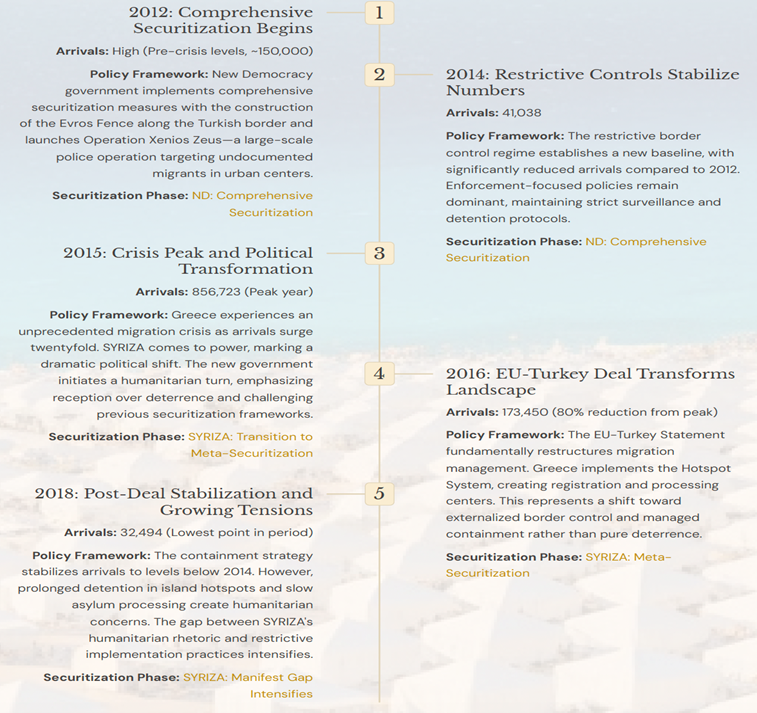
Source: Author’s compilation of information.
When the radical-left SYRIZA government assumed power in 2015, it initiated an intense discursive shift, constituting a Meta-Securitization.[34] SYRIZA explicitly rejected the premise that migrants constituted the existential threat. Instead, it designated the security practices of other actors, including the restrictive tactics of its predecessors and other EU member states, along with the “incoherent and indecisive approach of the EU,” as the real danger.[35] The referent object of security was strategically shifted from Greece’s domestic stability to the future of the European integration project and the protection of refugees’ human rights.[36] SYRIZA adopted emergency measures that aimed to achieve “Europeanization” of the crisis by successfully shifting the managerial and financial burden to the EU. Many of ND’s restrictive laws were annulled. The new government managed to successfully secure generous financial and administrative assistance by the EU.[37] The Meta-Securitization proved successful in its primary goal. It closed the European geopolitical Solidarity Gap by forcing collective EU engagement and obtaining massive external resources.
Despite the humanitarian discourse employed by SYRIZA, it was ultimately required to implement practical containment measures necessary to secure the collective EU action. The critical turning point was the EU-Turkey Statement of 2016, which allowed for the return of irregular arrivals from the Greek islands back to Turkey in exchange for aid and relocation promises.[38] To facilitate swift returns under this agreement, Greece adapted its reception infrastructure into the Hotspot system, utilizing closed facilities for containment. The Hotspot system generated a Manifest Discourse-Practice Gap. This is because the government’s humanitarian promise sharply contradicted the containment reality required by the EU to stabilize borders. The deplorable conditions in facilities like the Moria camp on Lesvos, characterized by extreme overcrowding and inhuman, degrading conditions,[39] represented the extreme manifestation of this contradiction. The situation could be defined as a Paradoxical Securitization, a state where the emergency measures nominally designed to safeguard human rights and EU values instead created profound insecurity for the very people they were meant to protect.[40] SYRIZA’s geopolitical success in securing resources directly necessitated a Manifest D-P Gap, as the practices demanded by the collective EU audience (some EU member states and EU Institutions) contradicted the SYRIZA’s stated normative goals.
Securitization Gaps in the COVID-19 Pandemic Response (2020)
The Greek government’s handling of the initial phase of the COVID-19 pandemic (between March and June 2020) was internationally lauded as a success story, achieving a low mortality rate through proactive and strict measures. What contributed to this relative success was the strong leadership, evidence-informed policymaking, and high initial public compliance.[41] The primary securitizing actors (the political elite of the ND government that returned to the overelegance of Greece in July 2019) operated closely with functional securitizing actors, specifically the scientific community and public health authorities.[42] It is because of this crucial collaboration that the government was allowed to frame the health emergency as a question of “science” against the “irrationality of populists and conspiracy theorists.”[43] As questions of science, the restrictive measures were depoliticized. The measures were presented as evidence-informed and necessary. Such a frame contributed to and accelerated immediate audience acceptance. The referent object of the securitization was clearly defined as Public Health and the survival of the Greek populace and health system.[44] To address the existential threat, the government enacted rapid and highly strict emergency measures, including a preemptive, multi-week lockdown. The regulation of citizen movement was intense, requiring mandatory text message (SMS) notification to a specific government number to justify leaving home for designated reasons.[45] The legal framework supporting these restrictions was based on the “necessity law” provision of Article 44 par. 1 of the Greek Constitution.[46] While this mechanism provided the speed and decisiveness essential for the initial public health success,[47] the concentration of power in the executive laid the structural groundwork for potential future normative issues. The study of Greece’s response to the COVID-19 pandemic suggests that rapid, successful securitization in an epidemiological crisis carried an extremely high structural cost for the Greek democratic institutions. Following the initial period of successful containment, the inevitable pressure to reconcile prolonged security measures with mounting economic devastation led to the emergence of the Discourse-Practice Gap. The tension between the discourse and the practice was particularly severe in Greece due to its heavy dependency on tourism.[48] The initial rhetoric framed Public Health as the singular, paramount priority.[49] However, the severity of the economic fallout because of the pandemic restrictions soon introduced a competing, implicit referent object, Greece’s Economic Stability. The government was forced to balance these two existential threats, resulting in policy inconsistency. One could observe this inconsistency in the fact that while tight internal movement controls, like the mandatory SMS system were imposed, at the same time the government allowed relatively open borders for international tourists during the summer season.[50] The situation could be described as a complex securitization as the government departed from a monolithic securitization, focusing solely on the virus, to securitizing also Greece’s economic stability. The perceived failure of the Greek government lay in its inability to fully merge or reconcile the competing narratives of public health and economic survival into a sustainable, cohesive policy framework.
The Normative Gap details the infringement of constitutional rights and the rule of law stemming from the reliance on exceptional state power. The legislative framework, utilizing the extensive use of Acts of Legislative Content under Article 44 par. 1, while operationally effective, risked the quality of democratic procedures by institutionalizing power centralization.[51] ND’s emergency measures imposed horizontal limitations on fundamental rights, specifically restricting freedom of movement, economic freedom, and, critically, freedom of assembly.[52] Subsequent phases of the pandemic witnessed detrimental legislative reforms regulating demonstrations and the implementation of “blanket bans on demonstrations,” directly compromising civil liberties.[53] The most damaging manifestation of the Normative Gap was the performative execution of these measures by Greece’s law enforcement agencies. Reports indicate that the enforcement of lockdown rules was often “overzealous,” leading to arbitrary arrests, the criminalization of peaceful protesters, and allegations of excessive and arbitrary force, contributing to an “alarming rise of human rights violations.”[54] The behavior of the ND government reveals a dangerous mission creep. The exceptional powers granted under the rubric of public health securitization were seemingly repurposed for managing internal dissent and maintaining social control. Although initially the security measures were effective against the virus (securing ontological security), the enforcement mechanisms became the source of profound normative insecurity. In such a context, the initial public health success turned into a long-term risk to the rule of law, exposing the very population secured from the epidemiological threat to systemic insecurity stemming from state overreach.
Discussion
Prioritization of Ontological Security over Identity Security
The comparison of the two crises reveals that securitization inherently involves fundamental trade-offs in crisis governance. In the Migration Crisis, between 2012–2015, the ND government prioritized Identity/Societal Security. Securing the national referent object, which was Greece, required externalizing and dehumanizing the threat, the lathro-metanastes. The political choice was to sustain a calculated legal violation (the Latent Normative Gap) in order to maintain high domestic political alignment. Conversely, the ND government during the COVID-19 Pandemic prioritized Ontological/Physical Security, the Public Health. Intense internal mobilization and cooperation was required to secure the immediate physical survival of the populace. The associated cost was normative security or else, the civil liberties, demonstrating that even a “just” securitization,[55] which successfully contains the initial threat, requires the temporary suspension or aggressive restriction of democratic principles.
The Persistence of Insecurity
The SGT framework enables a detailed distinction between the types of governance failure stemming from securitization. First, the study reveals contrasting normative failures. The nature of the Normative Gap shifted in accordance with the target of the exceptional measures. In the case of the securitization of migration by the ND government, we observe a Latent Normative Failure. The Greek authorities quietly breached basic international law provisions. The infringements were largely hidden from the domestic sovereign audience, directed primarily toward a marginalized, externalized population, the irregular migrants. In the case of the securitization of COVID-19 by the ND government, the normative failure was more overt. In particular, the breach of constitutional rights was aggressive, visible, and directed at the sovereign audience, the Greek citizens, through visible policing, movement restrictions, and legislative centralization. In this case, we witnessed a rapid, public, and high-stakes democratic erosion.
Except of the normative failures, the study revealed contrasting gaps between discourse and practice. The D-P Gaps emerged from different structural contradictions. During the Meta-Securitization of the migration crisis by SYRIZA, a Manifest D-P gap took place. The gap was between high-level rhetorical goals (humanitarian values, EU solidarity) and the operational reality imposed by the collective EU audience in exchange for resources (punitive containment via Hotspots). Another D-P gap is revealed from the study of the securitization of the COVID-19 pandemic by the center-right government. The gap was caused by the necessary political reconciliation between competing domestic existential threats. The inconsistency arose from the government’s inability to maintain the monolithic Public Health narrative when faced with the equally existential threat of Economic Stability tied to the vital tourism sector.
The Role of the Securitizing Actors and Audience in Gap Generation
As shown in Table 2, the underlying political logic of the New Democracy government remained relatively consistent, prioritizing rapid decision-making and political survival, regardless of the threat. In both migration (domestic alignment via illegal practices) and COVID-19 (rapid decisive action via necessity law) crises, the strategy leveraged exceptional measures that inevitably generated a normative deficit, whether externalized or internalized. In the case of SYRIZA, the Meta-Securitization of the migration issue offers a critical view of collective security dynamics. SYRIZA successfully changed the referent object to EU values but failed to fundamentally alter the underlying security practices. Thus, when a state engages in securitization involving resource acquisition, to close the Solidarity Gap, it often inherits the operational demands and punitive logic of the European audience.[56] SYRIZA’s Meta-Securitizers were constrained by the audience they successfully convinced, forcing the Manifest D-P Gap between the humanitarian discourse and the required containment reality.
Table 2. Comparative Securitization Gap Analysis
Analytical Element | Migration Crisis (ND/SYRIZA: 2012–2018) | COVID-19 Pandemic (ND: 2020) |
Primary Existential Threat | Irregular Migrants / Lack of EU Solidarity | Uncontrolled Spread of SARS-CoV-2 |
Referent Object (Security Target) | Greek Societal/Economic Security; EU Values/Human Rights | Public Health and Populace Survival |
Core Securitization Form | Comprehensive Securitization (ND); Meta-Securitization (SYRIZA) | Successful CSSS Move (Monolithic, then Complex Securitization) |
Primary Policy Failure Type | Latent Normative Gap (ND); Manifest D-P Gap (SYRIZA) | Normative Gap; Discourse-Practice Gap |
Key Policy Contradiction | Humanitarian Discourse vs. Punitive Containment Reality (Moria) | Public Health Priority vs. Economic Stability (Tourism) |
Major Insecurity Generated | Systemic violation of international law/human rights | Police overreach, rights infringement, democratic centralization |
Source: Author’s compilation of information
Conclusions
The application of the Securitization Gap Theory to Greece’s dual crisis experience provides a critical diagnosis of governance failure in response to extreme, prolonged stress. The dual case study confirms that the challenge for democratic states facing such crises is not simply achieving the initial securitization, but managing the subsequent complex securitization phase, where competing existential threats (geopolitical, economic, health) necessitate structural trade-offs that manifest as critical SGT failures. The analysis concludes that securitization, irrespective of its ideological framing and whether focused on internal order (ND) or collective normative rescue (SYRIZA), is structurally vulnerable to governance failures. The failures manifest either as latent legal breaches or as patent humanitarian and democratic crises. The ND government’s Comprehensive Securitization achieved strong domestic consensus in the migration context, but this required incurring a dangerous and unsustainable Latent Normative Gap by violating international obligations. Later, the SYRIZA government’s Meta-Securitization successfully secured resources but generated a profound Manifest Discourse-Practice Gap, demonstrating a critical failure in implementation due to the inherited demands of EU-level containment, leading to humanitarian catastrophe. During the COVID-19 pandemic, the ND response achieved high ontological security but only by generating an internal Normative Gap through aggressive state overreach and the centralization of executive power. The persistence of severe insecurity within containment facilities (Moria) and the internal political system (police mission creep during COVID-19) confirms that as long as securitization remains the default paradigm for crisis management, the recurrent politics of perpetual emergency will inherently jeopardize the rule of law and human rights.[57] The “Greek experience” holds profound implications for democratic crisis governance, emphasizing the urgent need for institutional safeguards to mitigate the normative costs of exceptional measures. Firstly, the widespread use of centralized executive power, such as the Acts of Legislative Content relying on the “necessity law,” demands the institutionalization of robust legislative or judicial oversight mechanisms to preempt the mission creep and the structural centralization of power that inevitably underpins the Normative Gap, ensuring that temporary exceptionalism does not convert into permanent executive authority. Secondly, national security policies must address the issue of structural non-alignment. The creation of the Latent Normative Gap in migration policy demonstrates that strategies driven solely by immediate domestic political survival often guarantee a conflict with the broader international legal and normative order. Policymakers must adopt sustainable, balanced approaches that preemptively mitigate the structural trade-offs between national interests and international legal obligations. Finally, the SGT framework itself serves as an essential diagnostic tool for political evaluation that forces policymakers and analysts to move beyond simple performance metrics to holistically assess the associated democratic and societal costs thus offering a more complete measure of governance success and resilience.
References
[1] G. Dimari, et al., Desecuritization of migration in Greece: re-visiting “flexicuritization”, “Frontiers in Political Science”, 2025, Vol. 7, pp. 1–13, DOI: 10.3389/fpos.2025.1462902; D. Stivas, Greece’s response to the European refugee crisis: A tale of two securitizations, “Mediterranean Politics”, 2023, Vol. 28, Issue 1, pp. 49–72, DOI: 10.1080/13629395.2021.1902198; I.N. Grigoriadis, E. Dilek, Securitizing Migration in the European Union: Greece and the Evros Fence, “Journal of Balkan and Near Eastern Studies”, 2019, Vol. 21, Issue 2, pp. 170–186, DOI: 10.1080/19448953.2018.1506280.
[2] B. Buzan, O. Wæver, J. de Wilde, Security: A new framework for analysis, Lynne Rienner 1998; O. Wæver, Securitization and Desecuritization, in: On Security, ed. R. Lipschutz, Columbia University Press 1995, pp. 46–86.
[3] Hellenic Parliament, The Constitution of Greece, 2022, https://www.hellenicparliament.gr/UserFiles/f3c70a23-7696-49db-9148-f24dce6a27c8/THE%20CONSTITUTION%20OF%20GREECE.pdf, (access 07.11.2025).
[4] B. Buzan, O. Wæver, J. de Wilde, Security: A new…, op. cit.; O. Wæver, Securitization and Desecuritization, op. cit., pp. 46–86.
[5] D. Stivas, Greece’s response to…, op. cit., pp. 49–72; B. Buzan, O. Wæver, J. de Wilde, Security: A new…, op. cit.
[6] D. Stivas, Greece’s response to…, op. cit., pp. 49–72.
[7] Ibidem.
[8] Ibidem.
[9] Ibidem.
[10] Ibidem.
[11] K. Oskanian, Securitisation gaps: Towards ideational understandings of state weakness, “European Journal of International Security”, 2021, Vol. 6, Issue 4, pp. 439–458, DOI: 10.1017/eis.2021.13.
[12] D. Stivas, Variations in the intensity of the securitization narratives at the EU level: securitizing the European refugee crisis, “Frontiers in Political Science”, 2024, Vol. 6, pp. 1–12, DOI: 10.3389/fpos.2024.1460531.
[13] Ibidem.
[14] Ibidem.
[15] N. Lampas, Did Securitization Fail to Contain the Covid-19 Pandemic? The Case of Greece, “HAPSc Policy Briefs Series”, 2020, Vol. 1, No. 2, pp. 35–41, DOI: 10.12681/hapscpbs.26453.
[16] D. Stivas, Variations in the intensity…, op. cit., pp. 1–12.
[17] Ibidem.
[18] G. Karavokyris, Constitutionalism and COVID-19 in Greece: The Normality of Emergency, Verfassungsblog 2021, https://verfassungsblog.de/constitutionalism-and-covid-19-in-greece-the-normality-of-emergency/, (access 07.11.2025); C. Saravakos, Police brutality in Greece: Another isolated incident?, Students For Liberty 2021, https://studentsforliberty.org/blog/police-brutality-in-greece/, (access 07.11.2025).
[19] D. Stivas, Greece’s response to…, op. cit., pp. 49–72.
[20] G. Dimari, N. Papadakis, The securitization of the Covid-19 pandemic in Greece: a just or unjust securitization?, “Quality and Quantity”, 2023, Vol. 57, pp. 77–97, DOI: 10.1007/s11135-022-01341-9.
[21] D. Stivas, Greece’s response to…, op. cit., pp. 49–72.
[22] Speech of Antonis Samaras at Syntagma Square, Enikos 2012, https://www.youtube.com/watch?v=SW6df5drPiw, (access 07.11.2025).
[23] N. Dendias on the migration issue: we face a new «invasion of the Dorians» [Ν. Δένδιας Για Μεταναστευτικό: Εχουμε Μια Νέα «Κάθοδο των Δωριέων»], Το Βήμα 2012, http://www.tovima.gr/society/article/?aid=469853, (access 07.11.2025).
[24] D. Stivas, Greece’s response to…, op. cit., pp. 49–72.
[25] Ibidem.
[26] K. Oskanian, Securitisation gaps: Towards…, op. cit., pp. 439–458.
[27] A. Dimitriadi, Irregular Afghan Migration to Europe. Migration, Diasporas and Citizenship, Palgrave Macmillan 2018.
[28] D. Skleparis, ‘A Europe without Walls, without Fences, without Borders’: A Desecuritization of Migration Doomed to Fail, “Political Studies”, 2017, Vol. 66, Issue 4, pp. 985–1001, DOI: 10.1177/0032321717729631; D. Skleparis, (In)securitization and illiberal practices on the fringe of the EU, “European Security”, 2016, Vol. 25, Issue 1, pp. 92–111, DOI: 10.1080/09662839.2015.1080160.
[29] D. Stivas, Greece’s response to…, op. cit., p. 57.
[30] Political Barometers about Immigration, 2008-2018, Public Issue 2019, http://www.publicissue.gr/category/pi/surveys/society/immigrants/, (access 07.11.2025).
[31] Ibidem.
[32] D. Stivas, Greece’s response to…, op. cit., pp. 49–72.
[33] Situation Europe Sea arrivals, UNHCR 2025, https://data.unhcr.org/en/situations/europe-sea-arrivals, (access 07.11.2025).
[34] D. Stivas, Greece’s response to…, op. cit., pp. 49–72.
[35] Ibidem.
[36] Ibidem.
[37] Ibidem.
[38] Implementing the EU-Turkey Statement – Questions and Answers, European Commission 2016, https://ec.europa.eu/commission/presscorner/detail/de/memo_16_1664, (access 07.11.2025).
[39] M. Gkliati, No more Morias? Notes from the field and the EU response, Statewatch 2021, https://www.statewatch.org/analyses/2021/no-more-morias-notes-from-the-field-and-the-eu-responses/, (access 07.11.2025).
[40] G. Karyotis, I. Paterson, A. Judge, Understanding Securitization Success: A New Analytical Framework, “International Studies Review”, 2025, Vol. 27, Issue 1, pp. 1–28, DOI: 10.1093/isr/viaf006; D. Stivas, Greece’s response to…, op. cit., pp. 49–72.
[41] S. Ladi, A. Angelou, D. Panagiotatou, Regaining Trust: Evidence-Informed Policymaking during the First Phase of the Covid-19 Crisis in Greece, “South European Society and Politics”, 2022, Vol. 27, Issue 4, pp. 551–576, DOI: 10.1080/13608746.2021.1983932.
[42] Ibidem.
[43] A. Chryssogelos, New democracy and centre-right dominance in Greece: a new normal?, “Southeast European and Black Sea Studies”, 2024, pp. 1–17, DOI: 10.1080/14683857.2024.2407415.
[44] G. Dimari, N. Papadakis, The securitization of the Covid-19…, op. cit., pp. 77–97.
[45] G. Karavokyris, Constitutionalism and COVID-19…, op. cit.
[46] C. Saravakos, Police brutality in Greece…, op. cit.
[47] G. Karavokyris, Constitutionalism and COVID-19…, op. cit.
[48] N. Lampas, Did Securitization Fail…, op. cit., pp. 35–41.
[49] S. Ladi, A. Angelou, D. Panagiotatou, Regaining Trust: Evidence-Informed…, op. cit., pp. 551–576.
[50] N. Lampas, Did Securitization Fail…, op. cit., pp. 35–41.
[51] G. Karavokyris, Constitutionalism and COVID-19…, op. cit.
[52] C. Saravakos, Police brutality in Greece…, op. cit.
[53] Greece: Freedom of assembly at risk and unlawful use of force in the era of COVID-19, Amnesty International 2021, https://www.amnesty.org/en/documents/eur25/4399/2021/en/, (access 07.11.2025).
[54] C. Saravakos, Police brutality in Greece…, op. cit.; Greece: Freedom of assembly…, op. cit.
[55] G. Dimari, N. Papadakis, The securitization of the Covid-19…, op. cit., pp. 77–97.
[56] G. Karyotis, I. Paterson, A. Judge, Understanding Securitization Success…, op. cit., pp. 1–28; D. Stivas, Greece’s response to…, op. cit., pp. 49–72.
[57] D. Stivas, Greece’s response to…, op. cit., pp. 49–72.