
Krzysztof Śliwiński
Full Article: View PDF
Licence: 
How to cite
Śliwiński K., From Securitization to Securitism. Analyzing the Evolution of the Securitization Theorem. Part II, “Polish Journal of Political Science”, 2026, Vol. 12, Issue 1, pp. 4–21, DOI: 10.58183/pjps.01012026.
ABSTRACT
This is the second part of the paper, which analyzes the evolution of securitization theory and introduces the concept of “securitism,” a permanent state of managed insecurity prevalent in Western societies. Building on the Copenhagen School’s framework and the (in)security concept by Didier Bigo and Anastasia Tsoukala, securitism reflects an illiberal ideology that enables political and economic elites to limit fundamental human rights progressively. Continuing from the first part, this paper analyzes three further drivers of securitism, namely: expertization of public policies, bureaucratization of public policy-making, and technocratism. The paper starts with a review of the securitism model, which will allow the reader to locate the following analysis in the general concept of securitism.
Keywords: securitization, securitism, individual rights
Introduction
This article is the second part of a study devoted to the concept of securitization and its contemporary manifestations. Referring to the earlier analysis,[1] the text develops the theoretical model presented there, focusing on the mechanisms driving the consolidation of this phenomenon.
Figure 1. Securitism Model
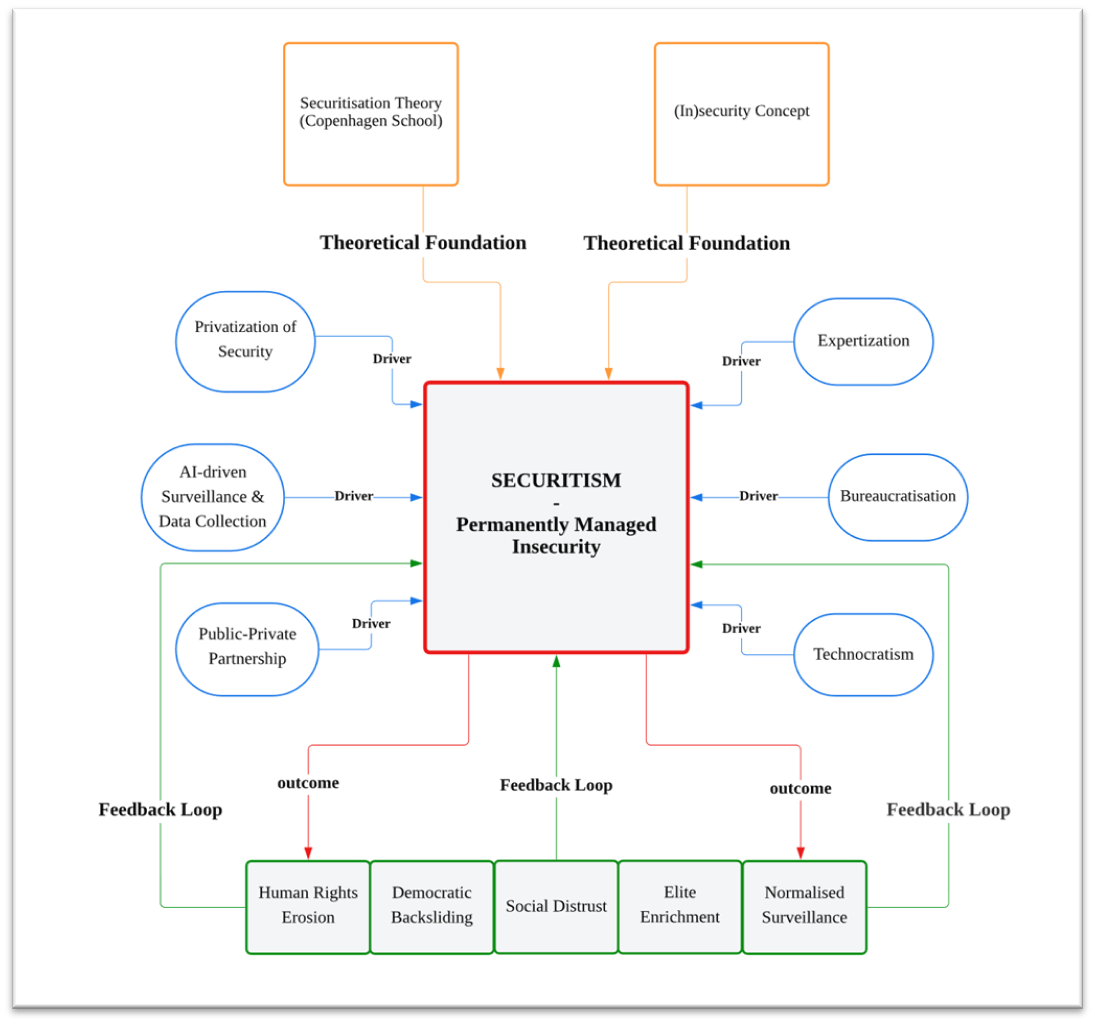
Source: own study.
“Expertization” of Public Policies: The Rise of Expert Governance as a Threat to Democratic Participation and Individual Freedoms
The increasing reliance on expert knowledge in public policymaking across Western democracies has fundamentally altered the nature of democratic governance. While proponents argue that technical expertise is essential for addressing complex contemporary challenges, critics contend that this “expertization” of politics undermines democratic accountability and threatens fundamental individual rights.
Expert involvement in policy-making has grown substantially across Western democracies, particularly during periods of crisis when governments delegate complex decisions to non-majoritarian bodies and advisory commissions.[2] The European Union’s response to the Eurozone crisis exemplifies this trend, where expert mechanisms and independent agencies increasingly shifted consequential economic choices away from ordinary parliamentary processes.[3] This institutional transformation represents a broader pattern of technocratic governance that has become embedded in democratic systems.
For example, recent research analyzing 1,545 Norwegian advisory reports demonstrates that expert outputs significantly influence policy when groups include political actors and possess adequate institutional resources.[4] This institutionalization of expert advice has created parallel governance structures that operate alongside, and sometimes in place of, traditional democratic institutions. The result is a hybrid system where technical knowledge increasingly shapes policy outcomes independently of electoral mandates.
The expansion of expert governance poses several fundamental challenges to democratic principles. Most critically, technocratic arrangements weaken the delegation chain between voters, parties, and executives, making electoral sanctioning of policy choices increasingly difficult.[5] When contentious decisions are transferred to expert forums, public political debate over distributional consequences is reduced, effectively depoliticizing choices that should remain subject to democratic contestation.[6]
This depoliticization creates what scholars term “elite insulation,” where meritocratic claims erode democratic responsiveness and citizen trust.[7] Policy accountability shifts toward markets or transnational coalitions rather than domestic electoral control, fundamentally hollowing out democratic governance.[8]
The erosion of democratic participation through expert governance raises serious human rights concerns. Robust accountability and pluralist politics serve as crucial safeguards for rights enforcement, and when technocratic governance marginalizes democratic contestation, the mechanisms that hold governments answerable for rights outcomes are weakened.[9] The removal of salient public contestation from major policy choices undermines the political conditions necessary to sustain human rights observance and provide effective remedies for violations.[10]
Transferring distributional or regulatory decisions to insulated expert bodies obscures winners and losers while shortening avenues for redress, thereby increasing risks to vulnerable populations.[11] This concern is particularly acute given emerging international discussions about a right to democratic governance itself, which underscores that democratic guarantees may constitute rights deserving institutional protection.[12]
Contemporary scholarship offers institutional and normative frameworks that diagnose how expert governance undercuts democratic participation. Moore’s analysis of democratic expertise identifies three models: implementational expertise (focused on efficient policy execution), alternative expertise (claiming superior legitimacy to electoral processes), and associative expertise (mobilizing expert knowledge around public aims).[13] Each model presents different risks to democratic governance, with alternative expertise posing the greatest threat to electoral accountability.
The Eurozone crisis and subsequent Economic and Monetary Union governance reforms illustrate these risks concretely. The establishment of expertized rules and independent agencies extended technocratic decision-making into distributional policy, prompting debates about a post-crisis technocratic order that prioritizes technical efficiency over democratic legitimacy.[14]
While expert knowledge remains essential for effective governance, its increasing dominance in Western policymaking threatens core democratic values and human rights protections. The challenge lies not in rejecting expertise entirely but in designing institutional arrangements that preserve epistemic quality while restoring visibility, contestability, and parliamentary control over policy agendas and decisions. Failure to address these concerns risks creating a technocratic order that undermines the very democratic foundations it claims to serve.
To illustrate the above, let us examine counterterrorism policies. Since the 11 September 2001 attacks, experts and think tanks have exerted outsized influence over counterterrorism policies in the United States and Europe, transforming security agendas into technocratic domains often insulated from public scrutiny. This dominance stems from their role as knowledge brokers, providing rapid analyses that governments prioritize amid crises, sidelining diverse voices, including civil society and affected communities. In the process, policies have prioritized preemptive security measures, eroding individual freedoms such as privacy, association, and due process.[15]
In the U.S., pre-9/11 terrorism scholars like Martha Crenshaw and Bruce Hoffman—dubbed the “terrorist mafia” – struggled for attention, as policymakers dismissed nuanced views of terrorism as rational political violence. Post-9/11, partisan think tanks like the Project for the New American Century (PNAC) gained traction, with ties to figures such as Dick Cheney and Donald Rumsfeld. PNAC’s advocacy for homeland defense and preemptive wars directly echoed the Bush administration’s doctrine, influencing the 2001 Authorization for Use of Military Force and invasions of Afghanistan and Iraq. Non-partisan efforts, such as RAND Corporation’s 2008 report on terrorist group endings through policing rather than military action, were largely ignored, as ideological urgency trumped evidence-based advice. This expert-driven shift entrenched a “forever war” paradigm, with policies like the USA PATRIOT Act expanding executive powers without robust congressional debate.[16]
Across Europe, particularly in the UK, think tanks have similarly steered policy through ideological framing of threats. Organizations like Policy Exchange (PX) and the Henry Jackson Society (HJS) promoted the “conveyor-belt theory” of radicalization, positing a linear path from Islamist ideology to violence, which informed the Prevent program launched in 2003.[17] PX reports, such as those defending Prevent against critics, shaped the 2023 Shawcross Review, emphasizing non-violent extremism and precautionary measures like preventive orders. Neoconservative think tanks like HJS influenced Tony Blair’s Iraq War support by attributing terrorism to “Islamic culture,” while establishment groups like the Royal United Services Institute (RUSI) offered tempered critiques but still bolstered securitization. This think-tank habitus marginalized “materialist” views, focusing on grievances like foreign policy, limiting policy pluralism.[18]
These expert-led policies have profoundly limited individual freedoms. In the U.S., the PATRIOT Act and NSA programs enabled mass surveillance, including metadata collection and National Security Letters accessing personal records without warrants, fostering a chilling effect on free speech and association – especially for Muslim communities targeted via ethnic profiling and No Fly Lists. Indefinite detention at Guantanamo Bay denied habeas corpus to hundreds, normalizing torture under “enhanced interrogation.” In the UK, Prevent’s ideological focus has spurred surveillance in schools and communities, profiling Muslims as potential threats and restricting civic space, with only 3.2% of the global population enjoying open discourse free from counterterrorism curbs. Such measures, often justified by UN Security Council Resolution 1373’s soft-law mandates, have disproportionately impacted minorities, women, and dissidents, enabling democratic backsliding through exceptional powers that evade proportionality.[19]
Few members of the public realize it but as this article is being written, in the USA for example, as of July 2025, 90 emergencies have been declared. 42 have expired and another 48 are currently in effect, each having been renewed annually by the president.[20] Importantly, 46 of the 48 active national emergencies invoke the International Emergency Economic Powers Act (IEEPA), which empowers the president to impose economic sanctions, freeze assets, and restrict transactions during declared emergencies. These measures can limit basic individual freedoms, particularly property rights (via asset freezes without immediate judicial review), due process (designations often lack full hearings), and freedom of movement (through travel bans or transaction prohibitions targeting designated persons). Critics, including the ACLU and Brennan Center, argue IEEPA’s broad application has enabled violations of civil liberties, such as indefinite asset seizures affecting U.S. citizens and residents without adequate recourse.[21]
The EU does not maintain a unified list of national emergencies, as these are handled at the member state level under national laws, with EU coordination via the Civil Protection Mechanism for cross-border aid. As of the writing of this paper (October 2025), no EU-wide emergency is active, though 18 member states (plus the EU) hold symbolic climate emergency declarations that do not operationalize powers. Active national declarations include localized states of emergency in countries like Germany (for security alerts amid protests) and France (for weather-related evacuations), totaling an estimated 5-10 based on recent reports of floods, wildfires, and security threats.[22] Of these, most (around 8) enable limitations on individual freedoms, such as restrictions on movement, assembly, and privacy under emergency powers, often justified for public safety but criticized for proportionality issues.[23] EU-level measures, like health emergency responses, add indirect impacts via coordinated restrictions.
Ultimately, while experts’ dominance has streamlined responses to terrorism, it has fostered authoritarian tendencies, underscoring the need for inclusive oversight to safeguard liberties.
Bureaucratization of Public Policymaking: Overregulation of the Private Sphere of Life and Legalism
Bureaucratization represents one of the most significant transformations in Western democratic governance, fundamentally altering how public policies are formulated, implemented, and legitimized. It is a process, characterized by the expansion of the administrative apparatus and the rationalization of governmental procedures.
Max Weber’s foundational analysis of bureaucratization remains central to understanding contemporary administrative governance. Weber conceptualized bureaucratization as the rise of rational-legal administration that can both enable and constrain political authority through routinization and rule-bound expertise.[24] Modern scholarship has expanded this framework through comparative institutionalism, emphasizing how national constitutional forms and civil-service designs condition bureaucratic roles and democratic accountability.[25]
The post-bureaucratic adaptation perspective identifies organizational responses, including networks, marketization, and flatter structures that alter how bureaucracy functions politically and operationally.[26] This evolution reflects the tension between administrative efficiency and democratic responsiveness that characterizes contemporary Western governance.
Empirical research demonstrates that bureaucratization has a significant impact on legislative productivity and policy agenda-setting. Studies of Denmark, the Netherlands, and Germany reveal that issue-specific ministerial drafting capacity unconditionally increases governmental legislative activity, while fragmented capacities across ministries reduce overall productivity.[27] Bureaucratic influence is particularly pronounced where politicians show limited interest or delegate broad discretion, allowing career officials to leverage expertise in shaping policy content.[28]
The concentration of technical expertise within ministries has created new dynamics in policy formulation. Commercial actors increasingly target bureaucrats rather than legislators, potentially steering policy toward industry preferences and raising concerns about democratic representation. Additionally, agencies’ procedural choices in rulemaking reflect strategic considerations about implementation feasibility and reputational management, thereby influencing democratic input into policy development.[29]
Bureaucratization affects policy implementation through resource allocation, institutional design, and interorganizational networks. Street-level bureaucrats rely on advice networks that produce significant variation in implementation practices, creating what scholars term “engaged,” “routine,” and “contested” approaches to policy execution. Limited time, budget, and expertise among elected officials push implementation burdens onto agencies, which adapt organizationally to manage these responsibilities.[30]
The democratic implications of bureaucratization are complex and contradictory. While bureaucracy can displace representative power, it may also function as a democratic safeguard when career civil service norms and legal review restrain partisan overreach.[31] However, executive rulemaking under delegated authority creates accountability deficits when procedural constraints such as transparency, public input, and judicial review are insufficient.[32]
Recent scholarship identifies several critical challenges facing bureaucratized governance in Western democracies. Politicized appointments and high turnover undermine consistent implementation and professional neutrality. Bureaucratization in Western public policy-making represents a fundamental tension between administrative capacity and democratic accountability. While it enables sophisticated policy development and implementation, it also creates risks of democratic displacement and capture by special interests. The challenge for contemporary Western democracies lies in institutional design that harnesses bureaucratic expertise while maintaining democratic responsiveness and legitimacy.
Let us then turn our attention to another case, where overregulation and legalism appear to be the primary drivers of securitization – climate-related policies. Nowhere is it more visible than in the case of the European Union.
The European Union’s ambitious climate change-related policies are designed to achieve carbon neutrality by 2050. Consequently, the EU has introduced a complex web of regulations and legal frameworks. While these measures are designed to combat environmental degradation, overregulation and legalism can inadvertently burden EU citizens, affecting their daily lives in economic, social, and practical ways.
Overregulation in climate policies often translates into higher costs for consumers. The EU’s Emissions Trading System (ETS) and carbon pricing mechanisms increase energy prices, as industries pass compliance costs onto households. For instance, in Germany, electricity prices rose by approximately 6% between 2019 and 2023 due to carbon taxes and renewable energy surcharges.[33] This affects low-income households disproportionately, forcing them to allocate a larger share of their budgets to utilities, thereby reducing their disposable income for other essentials, such as food or healthcare.
Stringent environmental standards, such as those outlined in the EU’s Green Deal, necessitate costly upgrades to meet emissions targets. For example, farmers in the Netherlands have protested regulations mandating reduced nitrogen emissions, which threaten their livelihoods by increasing operational costs or forcing them to cut production.[34] These economic pressures ripple into higher prices for goods and services, affecting consumers’ purchasing power.
Legalistic climate policies often impose lifestyle changes that can feel intrusive. The EU’s push for sustainable transport, including a ban on internal combustion engine vehicles by 2035, requires citizens to adapt to electric vehicles (EVs) despite the high upfront costs and inadequate charging infrastructure in rural areas. For instance, in countries like Poland, where EV adoption is below 5%, citizens face limited options for affordable, compliant vehicles, which restricts their mobility.[35]
Moreover, regulations promoting energy efficiency, such as mandatory building retrofitting, place additional burdens on homeowners. In France, the 2021 Climate and Resilience Law requires landlords to renovate properties to meet energy performance standards, leading to increased rents or property sales, which disrupt housing affordability.[36] These policies, while environmentally sound, can alienate citizens who perceive them as top-down impositions.
The bureaucratic complexity of climate regulations creates practical hurdles. For example, accessing EU subsidies for renewable energy or energy-efficient appliances often involves navigating convoluted application processes, deterring individuals and small enterprises.[37] In rural Spain, farmers report difficulties in complying with the Common Agricultural Policy’s environmental requirements due to unclear guidelines and frequent audits, which lead to stress and reduced productivity.[38]
Finally, let us remember the World Economic Forum-promoted individual carbon footprint tracker (ICFT) – a technology developed by Alibaba Group designed to help individuals monitor and calculate their personal carbon footprint—the total amount of greenhouse gases (primarily carbon dioxide and methane) produced by their daily activities, such as transportation, energy use, diet, and consumption habits. On the surface, it appears to be a good idea. The potential for the limitation of individual freedoms, once the technology becomes fully operational, is limitless.
Trackers that integrate with smartphones or smart meters, such as Joule or Earth Hero, rely on GPS, purchase data, or energy usage logs to estimate emissions. This data collection raises privacy concerns, particularly in light of EU regulations that mandate energy efficiency reporting. If governments or corporations integrate trackers into mandatory schemes – hypothetically, for carbon rationing – citizens could face intrusive monitoring of daily activities, from travel to diet, eroding personal privacy. Even voluntary apps risk data misuse if data are shared with third parties, which can foster distrust among users who are wary of surveillance.
Technocratism
Technocracy is not a new concept. It goes back at least a hundred years. Technocracy’s roots lie in early 20th-century ideas that emerged during a time of rapid industrialization and economic upheaval. The concept crystallized in the United States around the 1910s and 1920s, driven by engineers, scientists, and intellectuals who believed that technical expertise and scientific management could replace traditional political and economic systems with a more rational and efficient order.
Historically, the Progressive movement in the U.S. emphasized efficiency, scientific management, and reform. Figures like Frederick Winslow Taylor, with his “scientific management” principles, promoted optimizing industrial processes, which technocrats extended to governance and society. Economist and sociologist Thorstein Veblen, particularly in his 1921 book “The Engineers and the Price System,” argued that engineers and technical experts should oversee the economy, rather than the wasteful capitalist “businessmen.” He envisioned a “soviet of technicians” to manage society based on efficiency and production, not profit.[39]
The formal technocracy movement emerged during the Great Depression, when the economic collapse fueled widespread distrust in traditional systems. Engineers Howard Scott and Walter Rautenstrauch founded Technocracy Inc. in 1932, proposing a system in which experts would govern using scientific principles. They advocated replacing money with “energy certificates” to allocate resources based on energy consumption, reflecting a focus on measurable, scientific metrics.[40] The technological advancements of the Industrial Revolution (e.g., electricity, mass production) created a belief that science and technology could solve societal problems. This optimism underpinned technocratic ideas, as experts saw themselves as uniquely qualified to harness these advances for the benefit of society. Technocrats viewed capitalism as wasteful and democracy as inefficient, arguing that political decision-making often ignored scientific realities. This resonated during crises, such as the Depression, when faith in existing institutions faltered. The movement peaked in the 1930s but faded as economic recovery and World War II shifted priorities. However, technocratic ideas persist in modern governance, particularly in the emphasis on data-driven policy, expert-led institutions, and technological solutions to complex problems.
Technocracy, a form of governance led by technical experts rather than elected officials, faces significant criticism for undermining democratic principles and individual freedoms. Critics argue that technocratic rule fundamentally weakens the accountability mechanisms essential to democratic governance by loosening the delegation chain between voters, parties, and governments, thereby reducing opportunities for citizens to influence policy through normal democratic channels.[41]
A primary concern involves the depoliticization of policy choices. Technocracy treats complex social issues as purely technical problems, sidelining contestation about values and alternatives while narrowing the scope of public debate.[42] This approach can lead to what scholars term “technical closure of argument,” where specialized knowledge creates epistemic barriers that prevent lay citizens from challenging expert decisions or producing counter-expertise; when policy is framed as technical inevitability – such as economic “musts” – citizens and political parties struggle to articulate alternative normative projects.[43]
Technocracy also threatens individual autonomy through behavioral steering mechanisms. Technical systems and algorithmic defaults can replace citizen choice with expert-determined options, reducing opportunities for deliberative dissent and democratic override.[44] Critics warn that technocratic culture’s emphasis on instrumental rationality can marginalize moral and social values, reframing citizens as productivity units or risk profiles rather than rights-bearing individuals.[45]
Empirical studies from Europe and Latin America demonstrate these concerns in practice. Research on Chilean pension-reform advisory commissions shows how expert-dominated bodies can remove high-salience debates from democratic arenas while limiting social representation.[46] Similarly, European technocratic governments have been criticized for amplifying pre-existing weaknesses in party systems and democratic accountability.[47]
The tension between expert authority and democratic self-rule remains a central challenge. While technical competence is valuable, critics argue that preserving democratic legitimacy requires institutional safeguards, including judicial review, transparency requirements, inclusive advisory processes, and structured opportunities for public reasoning to ensure that expert knowledge serves rather than supplants democratic governance.[48]
Technocratism, as proposed in this paper, is less commonly used and lacks a standardized definition. However, it generally describes an ideology, attitude, or tendency to over-rely on or idealize technical expertise and technological solutions in decision-making or societal organization. It is more abstract, often critiquing an excessive faith in technology rather than a specific governance system.
The term technocratism emphasizes a cultural or philosophical bias toward technology as a primary solution to complex problems, sometimes at the expense of human, ethical, or cultural considerations. Broader than technocracy, the notion can apply to societal trends or individual mindsets, not just governance. For example, technocratism might describe Silicon Valley’s push for AI-driven solutions without addressing social inequalities. The term appears in critiques of over-optimism regarding technology’s role in addressing issues such as climate change or inequality, often tied to neoliberalism or digital transformation agendas. It is less about formal governance structures and more about a pervasive mindset, e.g., prioritizing data-driven policies over participatory ones.
In this sense, it is viewed as promoting a reductive view that technology can “fix” everything, potentially overlooking political or ethical complexities. It is often linked to dystopian fears of dehumanization or control by unaccountable systems.
In this work, technocratism is understood to be a constitutive part of securitism. Both as an ideology and as a state of affairs (an effect of securitization), securitism is highly dependent on a technocratic approach, which, as stated above, is not only anti-democratic in its spirit but, as a consequence, serves as a breeding ground for various limitations to individual freedoms.
Nowhere is this more evident than in the case of the collective West’s immigration policies. Countries such as the U.S., Canada, Australia, the UK, and a majority of EU members have been relocating large numbers of economic migrants from the South and Latin America, North Africa, the Middle East, South Asia, and Southeast Asia. The rationale behind such policies appears to be mainly economic and, in fact, technocratic, whereby millions of people are treated as no more than mere means of production that can be moved around the globe for the benefit of developed economies (mostly transnational companies) and without much regard for numerous societal consequences for both sending and hosting countries and their societies.
Since such policies will inevitably cause both positive and negative consequences (social and economic burdens or increased crime), the response of contemporary political and financial elites is simple yet chilling – more control over the individual. It is in this context that the EU has been pushing for a digital euro, and the Labour government in the UK is about to introduce digital ID. Both of these measures are presented to the public as convenient and providing security. The scope for future limitations on fundamental individual freedoms seems almost limitless. The recent decision of the Canadian government to shut down access for Canadian citizens who protested draconian anti-COVID-19 measures (mostly truck drivers) is a case in point. Another example sees the UK government ruthlessly applying anti-hate speech legislation, which leaves UK residents unable to criticize most of their government policies, especially regarding immigration.
Conclusions
This paper, the second part of a study on securitization, analyzes the evolution of securitization theory into “securitism,” defined as a permanent managed insecurity state prevalent in Western societies that progressively limits fundamental human rights. This paper explores three drivers of securitism: expertization of public policies, bureaucratization, and technocratism.
Expertization, especially in crisis contexts like counterterrorism and the Eurozone crisis, shifts policy decisions to non-majoritarian expert bodies, weakening democratic accountability and public contestation, which erodes individual freedoms such as privacy and due process.
Bureaucratization expands administrative apparatuses and legal frameworks, often resulting in overregulation that burdens citizens, as seen in EU climate policies imposing economic and lifestyle costs, and complicates democratic responsiveness.
Technocratism, an ideology favoring technical expertise and technological solutions, sidelines political debate and democratic participation, promoting a reductive view that technology can fix societal problems, while fostering authoritarian tendencies and limiting individual autonomy.
The paper illustrates these themes with cases like U.S. counterterrorism policies, EU climate regulations, and immigration controls, highlighting risks to democratic governance and individual rights. It argues for institutional designs that balance expertise with democratic legitimacy to prevent securitism from undermining democracy and fundamental freedoms.
References
[1] K. Śliwiński, From Securitization to Securitism. Analyzing the Evolution of the Securitization Theorem. Part I, “Polish Journal of Political Science”, 2025, Vol. 11, Issue 3 (Thematic Issue), pp. 4–16, DOI: 10.58183/pjps.0103TI2025.
[2] C. Holst, A. Molander, Responding to Crises—Worries About Expertization, in: The Palgrave Handbook of EU Crises, eds. M. Riddervold, J. Trondal, A. Newsome, Palgrave Macmillan 2021, pp. 647–665.
[3] I. Sánchez-Cuenca, From a deficit of democracy to a technocratic order: The postcrisis debate on Europe, “Annual Review of Political Science”, 2017, Vol. 20, pp. 351–369, DOI: 10.1146/ANNUREV-POLISCI-061915-110623.
[4] J. Christensen, S. Hesstvedt, The influence of expert groups: a citation analysis, “Journal of European Public Policy”, 2023, Vol. 31, Issue 5, pp. 1259–1294, DOI: 10.1080/13501763.2023.2174168.
[5] G. Pastorella, Technocratic Governments in Europe: Getting the Critique Right, “Political Studies”, 2016, Vol. 64, Issue 4, pp. 948–965, DOI: 10.1111/1467-9248.12217.
[6] I. Sánchez-Cuenca, From a deficit…, op. cit., pp. 351–369.
[7] E. Bertsou, D. Caramani (eds.), The technocratic challenge to democracy, Routledge 2020, DOI: 10.4324/9780429342165.
[8] A. Ruser, By the markets, of the markets, for the markets? Technocratic decision making and the hollowing out of democracy, “Global Policy”, 2015, Vol. 6, Issue S1, pp. 83–92, DOI: 10.1111/1758-5899.12231.
[9] J. Tasioulas, “Fantasy Upon Fantasy”: Some Reflections on Dworkin’s Philosophy of International Law, “Jus Cogens”, 2021, Vol. 3, pp. 33–50, DOI: 10.1007/S42439-021-00036-3.
[10] Ibidem.
[11] I. Sánchez-Cuenca, From a deficit…, op. cit., pp. 351–369.
[12] S. Marks, What has become of the emerging right to democratic governance, “European Journal of International Law”, 2011, Vol. 22, Issue 2, pp. 507–524, DOI: 10.1093/EJIL/CHR023.
[13] A. Moore, Three Models of Democratic Expertise, “Perspectives on Politics”, 2021, Vol. 19, Issue 2, pp. 553–563, DOI: 10.1017/S1537592720002480.
[14] F. Losada, A Democratic Legitimacy Assessment of Recent Governance Mechanisms in Economic and Monetary Union, “Helsinki Collegium for Advanced Studies”, 2013, Vol. 14, pp. 26–60.
[15] D.E. Abelson, A War of Ideas: Think Tanks and Terrorism, https://irpp.org/wp-content/uploads/assets/po/equalization-and-the-federal-spending-power/abelson.pdf, (access 10.07.2025).
[16] M. Burrows, Nasty, Brutish, and Short: Scholars, Think Tanks, and Influence on Policymaking, STIMSON 2024, https://www.stimson.org/2024/nasty-brutish-and-short-scholars-think-tanks-and-influence-on-policymaking/, (access 10.07.2025).
[17] Written Evidence Submitted by AbdusSabur Qutubi, https://committees.parliament.uk/writtenevidence/62227/pdf, (access 10.07.2025).
[18] The UK Counter-Terrorism Strategy: A Return on Investment, RUSI 2013, https://www.rusi.org/explore-our-research/publications/commentary/uk-counter-terrorism-strategy-return-investment, (access 10.07.2025).
[19] PATRIOT Act, Surveillance Oversight, https://epic.org/issues/surveillance-oversight/patriot-act/, (access 10.07.2025).
[20] List of national emergencies in the United States, https://en.wikipedia.org/wiki/List_of_national_emergencies_in_the_United_States, (access 10.07.2025).
[21] Congressional Research Service, The International Emergency Economic Powers Act: Origins, Evolution, and Use, 2025, https://www.congress.gov/crs_external_products/R/PDF/R45618/R45618.16.pdf, (access 10.07.2025).
[22] Climate Emergency Declarations in 2,366 Jurisdictions and Local Governments Cover 1 Billion Citizens, Climate Emergency Declaration 2025, https://climateemergencydeclaration.org/climate-emergency-declarations-cover-15-million-citizens/, (access 10.03.2025).
[23] EU Civil Protection Mechanism, European Commission, https://civil-protection-humanitarian-aid.ec.europa.eu/what/civil-protection/eu-civil-protection-mechanism_en, (access 10.07.2025).
[24] N. Fleet, Racionalización y poder: La cuestión de la legitimidad en Weber como referente de la acción política, “Revista Temas Sociológicos”, 2007, Vol. 12, pp. 215–250, DOI: 10.29344/07196458.12.224.
[25] K.J. Klüser, From bureaucratic capacity to legislation: how ministerial resources shape governments’ policy-making capabilities, “West European Politics”, 2023, Vol. 46, Issue 2, pp. 347–373, DOI: 10.1080/01402382.2022.2030602.
[26] M.E. Compton, K.J. Meier, Bureaucracy to Postbureaucracy: The Consequences of Political Failures, in: Oxford Research Encyclopedia of Politics, Oxford University Press 2017, DOI: 10.1093/ACREFORE/9780190224851.013.127.
[27] K.J. Klüser, From bureaucratic capacity…, op. cit., pp. 347–373.
[28] C.P. Duarte, Ministérios e burocracia no processo de produção de políticas públicas, “Teoria & Pesquisa Revista de Ciência Política”, 2024, Vol. 33, pp. 1–25, DOI: 10.14244/tp.v33i00.1033.
[29] J. Park, Procedural Politicking for What? Bureaucratic Reputation and Democratic Governance, “Journal of Public Administration Research and Theory”, 2024, Vol. 34, No. 4, pp. 567–582, DOI: 10.1093/jopart/muae020.
[30] M.E. Compton, K.J. Meier, Bureaucracy to Postbureaucracy…, op. cit.
[31] B. Sánchez, F. Javier, La burocratización del poder político: notas sobre sus consecuencias en las democracias parlamentarias, “Revista de Estudios Políticos”, 2017, Vol. 175, pp. 123–148.
[32] S. Rose-Ackerman, Democracy and Executive Power: Administrative Policymaking in Comparative Perspective, “Revista de derecho público”, 2022, Vol. 6, pp. 978–1002, DOI: 10.37417/rpd/vol_6_2022_978.
[33] German Net Power Generation in First Half of 2023: Record Renewable Energy Share of 57.7 Percent, Fraunhofer Institute for Solar Energy Systems ISE 2023, https://www.ise.fraunhofer.de/en/press-media/press-releases/2023/german-net-power-generation-in-first-half-of-2023-renewable-energy-share-of-57-percent.html?ref=upstract.com, (access 10.03.2025).
[34] S. Brouwer, D. Huitema, Policy Entrepreneurs and Strategies for Change, “Regional Environmental Change”, 2017, Vol. 18, pp. 1259–1272, DOI: 10.1007/s10113-017-1139-z.
[35] State of European Transport 2024, T&E, https://www.transportenvironment.org/state-of-european-transport/state-of-transport/cars, (access 09.10.2025).
[36] M. Jousseaume, The French Climate and Resilience Law, “cepInput”, 2022, No. 1, pp. 1–13, https://www.cep.eu/fileadmin/user_upload/cep.eu/Studien/cepInput_Franzoesisches_Klima-_und_Resilienzgesetz/cepInput_The_French_Climate_and_Resilience_Law.pdf#:~:text=On%2013%20July%202021%2C%20the%20French%20Parliament,the%20new%20EU%20climate%20target%20for%202030, (access 09.10.2025).
[37] EU Budget’s Contribution to Climate Action Overstated, European Court of Auditors 2022, https://www.eca.europa.eu/en/Pages/news.aspx?nid=16559#:~:text=%E2%80%8B%E2%80%8BThe%20EU%20has,climate%20relevance%20of%20agricultural%20funding.%E2%80%9D, (access 09.10.2025).
[38] Policies for the Future of Farming and Food in Spain, OECD 2025, https://www.oecd.org/en/publications/policies-for-the-future-of-farming-and-food-in-spain_a93d26be-en/full-report/component-5.html#chapter-d1e1597-5ea48de004, (access 09.10.2025).
[39] T. Veblen, The Engineers and the Price System, Batoche Books 2001.
[40] Entry “technocracy”, in: Encyclopedia Britannica, https://www.britannica.com/topic/technocracy, (access 09.10.2025).
[41] M. Białobłocka, Technocratic Governance and Democracy: Key Contradictions, Their Consequences and Ways to Overcome, “Studium Europy Środkowej i Wschodniej”, 2014, pp. 224–234, https://jcee.wsgk.com.pl/?page_id=2041, (access 09.10.2025).
[42] I. Sánchez-Cuenca, Neoliberal Technocracy: The Challenge to Democratic Self-Government, in: The Technocratic Challenge to Democracy, eds. E. Bertsou, D. Caramani, Routledge 2020, pp. 44–60.
[43] M. Ferrera, Technocracy: Practice or ideology?, in: Politics and Social Visions: Ideology, Conflict, and Solidarity in the EU, Oxford University Press 2024, pp. 195–221.
[44] P.A.E. Brey, Ethical Aspects of Behavior-Steering Technology, in: User Behavior and Technology Development, eds. P.P. Verbeek, A. Slob, Kluwer, pp. 357–364.
[45] E. Dargent, Technocracy and Democracy in Latin America: The Experts Running Government, Cambridge University Press 2014.
[46] G. Pastorella, Technocratic Governments in Europe: Getting the Critique Right, “Political Studies”, 2016, Vol. 64, No. 4, pp. 948–965.
[47] E. Bertsou, D. Caramani (eds.), The Technocratic Challenge…, op. cit.
[48] Ch.J. Bickerton, C.I. Accetti, Technocracy and Political Theory, in: The Technocratic Challenge to Democracy, eds. E. Bertsou, D. Caramani, Routledge 2020, pp. 29–43.