
Dawid Pieniężny
Full Article: View PDF
Licence: 
How to cite
Pieniężny D., Secularization as a Potential Factor Influencing the Party System in Poland – an Initial Outline of the Problem, “Polish Journal of Political Science”, 2026, Vol. 12, Issue 3, pp. 43–61, DOI: 10.58183/pjps.04032026.
ABSTRACT
According to a study by the Pew Research Center, out of the 108 countries analyzed in 2018, Poland led the decline in religiosity from one generation to the next. Polish society, and especially its youngest members, is becoming secular at a very rapid pace. So rapidly, in fact, that it is reasonable to assume that rapid secularization alters patterns of political competition and voter preferences, although the direction of these changes is not predetermined and may benefit both liberal and right-wing anti-establishment parties. The aim of this article is to attempt to explain whether the shift in the axiological paradigm in Poland is reflected in changes within the party system. Through the analysis of existing sources and desk research, it has been demonstrated that political parties are often forced to alter their platforms in pursuit of increasingly secular voters who express a negative attitude toward the Catholic Church, a trend that generates significant changes within the party system.
Keywords: parliamentary elections, political change, party system, political parties
Introduction
As early as the 1990s, a wave of secularization swept across Western Europe.[1] In countries such as France and Belgium, the proportion of people who consider themselves to be affiliated with the Christian faith has fallen sharply.[2] Just a dozen or so years ago, such a situation was something of an abstraction in Poland.[3] Nevertheless, the processes of secularization have had a significant impact on Poland.
For political scientists, although this may appear unrelated to politics, it is an extremely important situation, as in Western European countries, in the face of growing secularization of society – understood as a process involving the secularization of institutions and various aspects of social, political, and cultural life, and their liberation from the influence of religion and the clergy.[4] The political parties’ manifestos have also undergone changes, as they have had to adapt to the new circumstances in order to secure electoral success.[5]
Political groups classified as right-wing or center-right have often had to deviate from their original platforms in order to appeal to an increasingly liberal-minded public, or else become more radical, entrenching themselves among their core electorate and often evolving in a populist direction.[6] Although secularization may increase support for liberal and left-wing parties by reducing the importance of religious cleavages, this relationship is not linear. Contemporary European party systems demonstrate that declining religiosity may also strengthen anti-establishment, nationalist or libertarian parties, particularly among younger voters. Consequently, secularization should be understood as a factor reshaping electoral competition rather than determining a single ideological direction of political change. This has led to profound political changes, exemplified by the fact that, whereas just a few decades ago many parliaments were embroiled in fierce internal battles over abortion – with parties regarded as Christian Democratic dominating the debate in defense of a position consistent with Christian principles[7] – today in Western Europe, it is regarded as a hallmark of civilization, and among the younger generation even as a form of contraception.[8] The aim of this article is to attempt to determine whether, in the face of a shift in the axiological paradigm, similar changes within the party system are also evident in Poland.
To achieve this aim, the following research questions have been proposed: (1) Has Polish society experienced a measurable shift away from traditional Christian moral norms, as reflected in public attitudes toward abortion, family, LGBT rights, religion in public life and Church–state relations? (2) Are changes taking place within the Polish party system toward patterns observed in Western Europe at the turn of the 20th and 21st centuries? (3) Are Polish political parties being forced to move away from conservative demands in their search for new voters?
In this article, the term “Christian values” is not understood as the entirety of religious doctrine, but as a set of moral norms traditionally promoted by the Catholic Church and present in public debate in Poland. For the purposes of this study, these have been operationalized through positions on selected bioethical and social issues that are the subject of political controversy, in particular: the protection of life from conception (abortion), the rights of LGBT people, the family model, the place of religion in public life, and the relationship between the state and the Church. A shift in the moral paradigm therefore signifies an increase in social and political acceptance of positions that depart from the traditional teachings of the Catholic Church in the areas mentioned.[9] This article therefore seeks to outline the potential changes taking place within political parties in Poland, moving in a direction once observed in Western Europe – that is, either a shift in their policies towards liberalism or a radicalization towards populism.[10]
Two main research methods were employed in the course of the analysis. The first of these is desk research. The study employs a qualitative comparative research design combining secondary statistical data with document analysis. The empirical material consists of: (1) survey data on religiosity and moral attitudes published by the Public Opinion Research Center (CBOS), Statistics Poland (GUS), the Pew Research Center, and other publicly available sources; (2) official electoral programs and policy documents of the main Polish political parties participating in parliamentary elections; and (3) relevant scholarly literature on secularization and the party system in Poland.
To ensure analytical consistency, all party programs were examined using the same analytical framework. The analysis focused on five thematic categories closely related to the moral and cultural dimension of political competition: (1) abortion and the protection of life, (2) LGBT rights and family policy, (3) the role of religion in public life, (4) Church–state relations, and (5) references to Christian values and national identity. The study includes political parties that obtained parliamentary representation during the analyzed period and significantly influenced public debate on moral and religious issues. This criterion ensured comparability across electoral cycles while focusing on actors shaping the evolution of the Polish party system.
The analysis focuses on selected issues reflecting the relationship between politics and traditional Christian morality, including abortion, LGBT rights, family policy, the role of religion in public life and Church–state relations. Party programs were analyzed qualitatively with particular attention paid to changes in declared positions across consecutive elections. Statistical data were used to identify long-term trends in religiosity and public attitudes, allowing comparison between societal value change and political party positioning, with a particular focus on the period 2005–2023. The decision to begin the analysis in 2005 is justified by the fact that this marked the start of the political duopoly between Law and Justice (Prawo i Sprawiedliwość – PiS) and the Civic Platform/Civic Coalition (Platforma Obywatelska/Koalicja Obywatelska – PO/KO), and thus the beginning of the consolidation of the party system into the form we see today. This, in turn, allows for an analysis of changes in the platforms and policy positions of the two largest political parties operating within the Polish party system. The year the study concludes – 2023 – is the date of the last parliamentary election.
Conceptual Framework
Whenever this work refers to the “left” or “liberalism,” as well as to their opposites, the “right” and “conservatism” – I use these terms in accordance with the premise of Waldemar Wojtasik, who aptly observed that at the beginning of the 19th century, the Left began to be identified with liberalism, while the Right with conservatism. This division, however, did not concern only axiology (worldview). Over time, this distinction also came to apply to the socio-economic dimension of these ideologies.[11]
However, whenever this paper addresses the views in question, it does so exclusively in relation to their ideological component, given the specific nature of the Polish party system, in which the ideological and economic aspects of each approach are often mutually exclusive.[12] The accepted definitions are as follows: Conservatism is a socio-political stance characterized by an attachment to tradition and the existing value system, as well as a reluctant or hostile attitude toward major social change.[13] Liberalism, on the other hand, is a socio-political attitude characterized by understanding, openness and tolerance toward other people’s attitudes, views or actions, and which rejects dogmatism in thinking and an authoritarian style of behavior.[14]
There is also a need to clarify concepts such as secularization, which is thus understood as “the process of secularizing social and cultural life, etc., freeing it from the influence of religion and church organizations, and the diminishing role of religious ties in society; it is linked to the development of knowledge and science, changes in the model of social and family life, etc., and, as a result, to transformations in the sphere of attitudes, views and the value system (worldview) of society.”[15]
The final concept that needs to be clarified is the party system. This study adopts the following definition: “the configuration of political parties within a specific national political system” and “the network of interrelationships between political parties.” It should be emphasized, however, that in the Polish context, this refers to a competitive party system,[16] amidst significant social and political polarization.[17]
It should therefore be emphasized that the relationship between processes of secularization, understood in this way, and changes in political preferences is not deterministic. A decline in the importance of religion in social life does not necessarily lead automatically to increased support for left-wing or liberal groups. Secularization primarily signifies a reduction in the influence of religious institutions on the formation of citizens’ attitudes, while the direction of political socialization may be shaped by a range of other factors, such as a sense of economic insecurity, migration crises, political polarization, social media or changes in patterns of political communication. As a result, voters moving away from traditional religious norms may identify with both progressive groups and those appealing to nationalist, anti-establishment or libertarian ideals. A good example is contemporary Poland, where a significant proportion of young, less religious voters declare their support for Confederation (Konfederacja). This phenomenon indicates that a decline in religiosity does not automatically mean a shift in political preferences towards the left, but rather a weakening of the traditional axis of conflict based on religion and the opening up of space for new political divisions, linked, among other things, to identity, attitudes towards the state, economic freedom and cultural issues.
For this reason, in this article, secularization is treated not as a direct cause of the rise in support for a particular ideological current, but as one of the factors increasing the fluidity of electoral behavior and prompting political parties to redefine their programs and communication strategies.
Is Poland no Longer a Catholic Country?
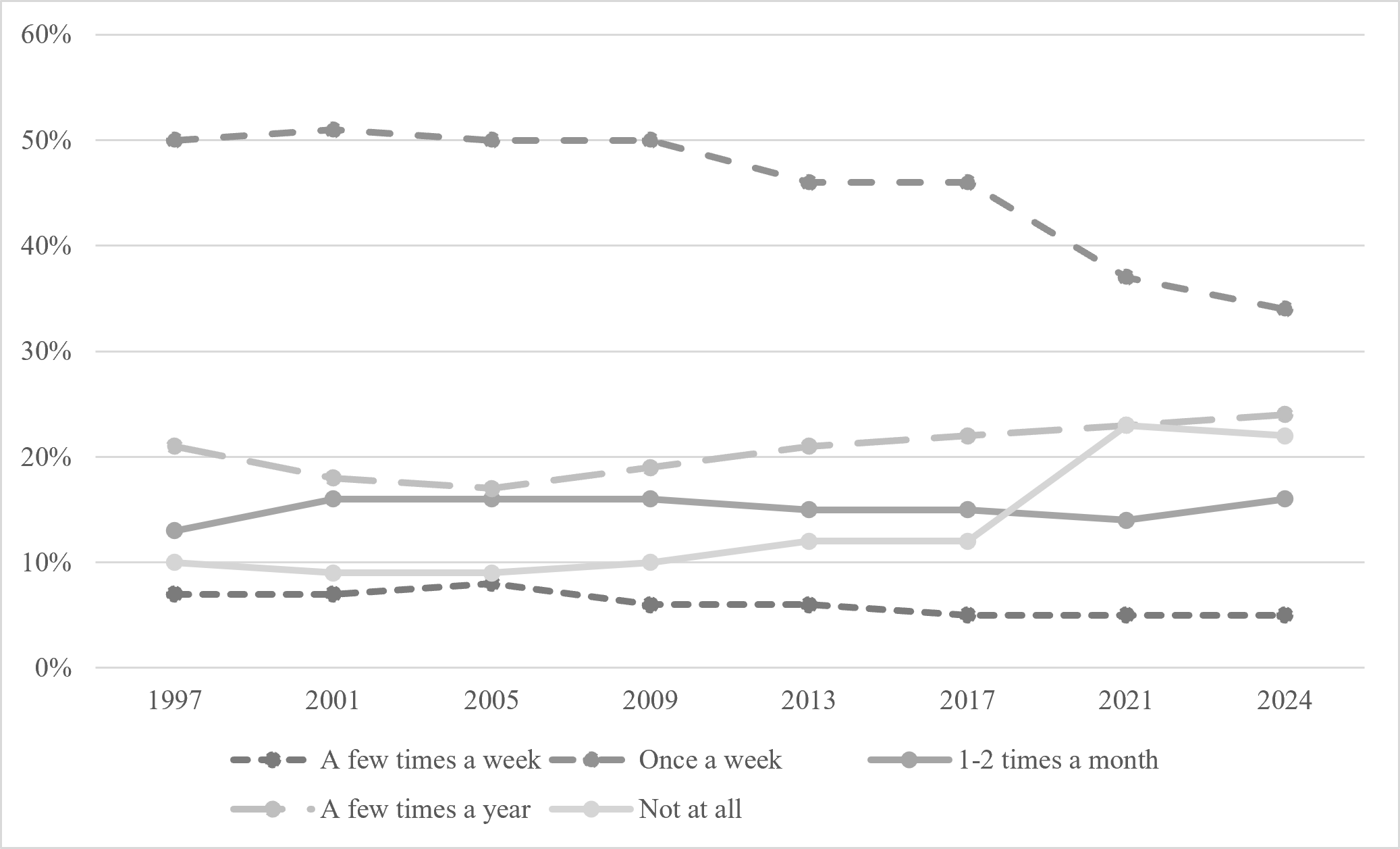
As recently as 2004, Mirosława Grabowska wrote: “I see no compelling reasons to believe that Polish society will undergo a rapid process of secularization. Faith and religious practices remain widespread and are closely intertwined with individual morality, as well as social, civic and political life.”[18] That was indeed the case. According to the “Concise Statistical Yearbook of Poland,” published in 2005 by the Central Statistical Office, Catholics accounted for 96% of the total population.[19] Since then, however, this figure has fallen steadily, reaching 84.8% in 2021.[20] It is worth noting, however, that in Statistics Poland surveys, Catholics are defined as those baptized into the faith who have not formally renounced it. An attempt to determine the actual percentage of Catholics in Poland was made using the results of the National Census, which showed that only just over 70% of respondents declared their faith.[21] This is confirmed by a survey of the frequency of religious practices among Poles.
Figure 1. Poles’ reported religious practices, 1997–2024
Source: Author’s own study based on: M. Bożewicz, Religijność Polaków w ostatnich dziesięcioleciach – Komunikat z badań nr 50/2024, Public Opinion Research Center 2024.
The proportion of practicing Catholics is steadily declining. Conversely, the proportion of non-practicing Catholics is rising sharply. In surveys conducted by the Institute of Catholic Church Statistics, the situation for the institution is even worse. The dominicantes index – that is, the proportion of people attending Sunday Mass in Poland – stood at 28% in 2021, the lowest figure in the history of the surveys.[22] Of course, the pandemic situation has played a significant role here, as it has had a major impact on church attendance due to the temporary closure of places of worship during the COVID-19 outbreak; however, the situation has not improved since these restrictions were lifted.
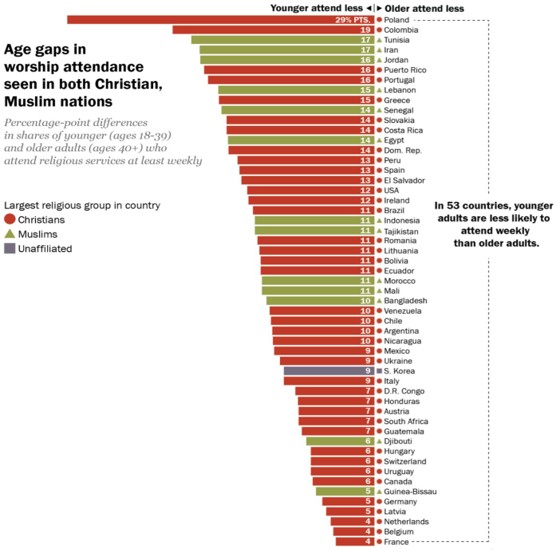
The situation of growing secularization in Polish society seems to be most clearly illustrated by a 2018 report from the Pew Research Center. The study examined the rate of decline in religious affiliation from one generation to the next across as many as 108 countries worldwide, not limited to Catholic nations. The average decline in religiosity from one generation to the next in these countries, as estimated by the researchers, was expected to be between 5 and 9 percent. In Poland, as the chart below shows, the figure fell well outside the expected range.
Figure 2. Countries experiencing a decline in religious belief from one generation to the next
Source: The Age Gap in Religion Around the World, Pew Research Center 2018, https://www.pewresearch.org/religion/2018/06/13/the-age-gap-in-religion-around-the-world/, (access 23.05.2026).
The graph clearly shows that Poland led the way in the decline in religious observance from one generation to the next. As many as 29% fewer people aged 18–39 practiced their religion than those aged 40 and over. What is more, the research shows that religion was very important at that time for 40% of people over 40 and for only 16% of people under 40.[23] These findings clearly show that secularization, particularly among the younger generation, is a current and rapidly evolving phenomenon in Poland.
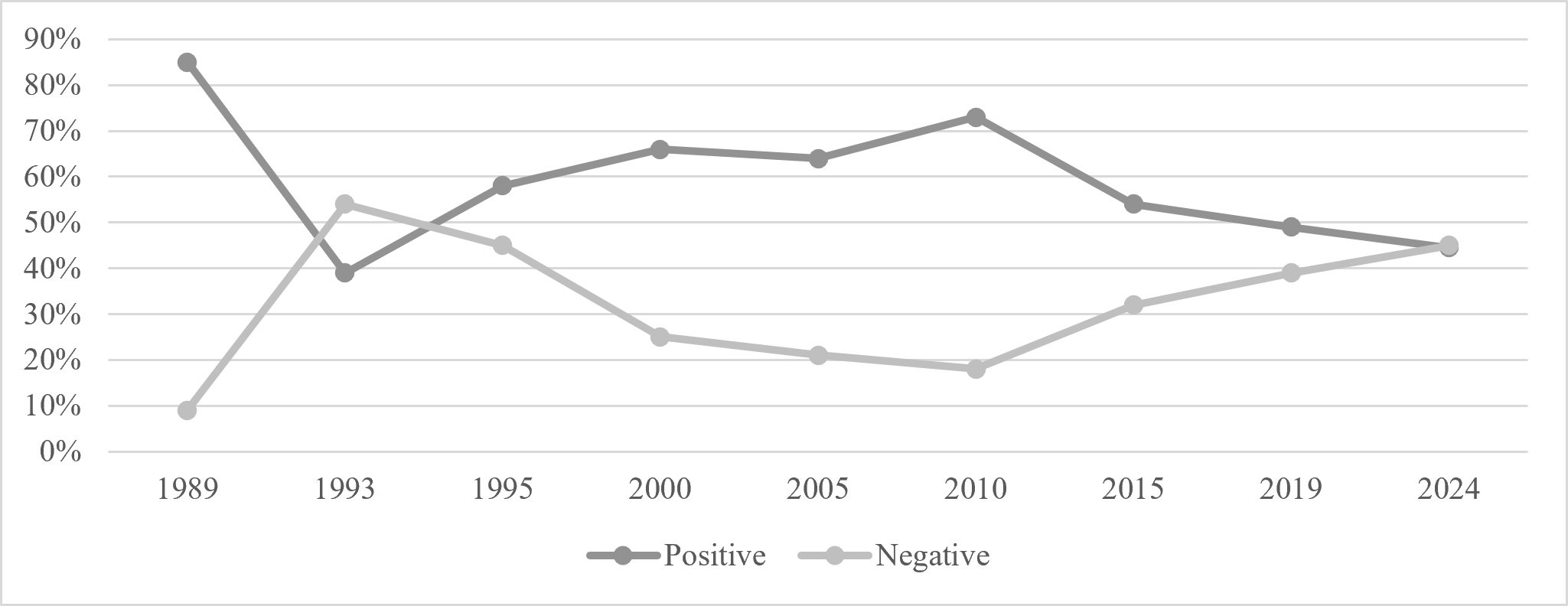
When analyzing the decline in religiousness among Poles, particularly among young people, we must seek the causes of this situation. There may be many such causes. I will draw on the 2024 report by the Public Opinion Research Center, which compiles Poles’ views on the Catholic Church over the years, to assist with this analysis.
Figure 3. Assessments of the Catholic Church’s activities in Poland between 1989 and 2024
Source: Own study based on: M. Feliksiak, Oceny działalności instytucji publicznych w marcu – Komunikat z badań nr 36/2024, Public Opinion Research Center 2024.
The graph above shows that, during the first eight years following the transition to democracy, there was only one instance in which Poles’ assessment of the Catholic Church’s activities was significantly more negative than positive. Delving into the reasons for this, three main factors can be identified. Firstly, there was the passing of the Family Planning Act, or the so-called anti-abortion law, introducing the “abortion compromise”[24] and the significant role played in this situation by the Catholic Church in Poland, which acted as a pressure group on politicians to reduce, if not completely eliminate, the rate of pregnancy terminations in Poland.[25] It was also the period during which the Concordat between the Holy See and the Republic of Poland was signed.[26] This document, which granted a number of privileges to members of the clergy – particularly in economic matters, tax issues and the restitution of land confiscated during the wars and under the People’s Republic of Poland – was widely criticized in the public sphere.[27] The third factor, in my view, is what Józef Tischner called the “unfortunate gift of freedom” – that is, a kind of “intoxication” with freedom and the initial desire for people to free themselves from the role of the “conscience of the nation” entrusted to the Church.[28]
This graph also shows that the Catholic Church is currently facing yet another crisis of this magnitude. It also appears that this crisis is even greater – the greatest in the modern history of this institution in Poland. When analyzing the current situation, it is important to take into account successive periods of deterioration in the image of the Catholic Church in Poland, understood as a decline in the level of public trust and an increase in negative assessments of its public role. The first significant deterioration in this image occurred following the Smolensk air disaster in 2010, when regular, monthly commemorative ceremonies for the victims of the disaster began to be organized in the public sphere. Church structures, including the clergy and liturgical practices such as the celebration of Mass, were involved in these events to varying degrees. Their regular nature and strong links to the political and social narrative contributed to the gradual polarization of public opinion, which may have influenced further changes in the perception of the Church as an institution.[29] Recent years have seen a series of other major crises affecting the Catholic Church’s image in Poland, the greatest of which is, of course, the issue of allegations against clergy regarding the sexual abuse of minors. It was precisely pedophilia among the clergy that topped the list in a survey conducted by the Public Opinion Research Center in 2019.
Table 1. The problems facing the Catholic Church in Poland, as seen by Poles
|
In your opinion, what problems is the Catholic Church in Poland facing? |
VIII 2013 |
VII 2019 |
|
In per cent |
||
|
Pedophilia among clergy/priests |
43 |
60 |
|
The Church’s involvement in politics |
28 |
37 |
|
The exodus of the faithful from the Church, the decline in religious observance |
26 |
29 |
|
Homosexuality amongst clergy/priests |
29 |
20 |
|
Priests expressing their political views during sermons |
16 |
20 |
|
Excessive fees charged in connection with the sacraments |
22 |
19 |
|
The high standard of living enjoyed by clergy/priests |
23 |
18 |
|
Failure by clergy/priests to observe celibacy |
18 |
15 |
|
Alcoholism amongst clergy/priests |
19 |
7 |
|
Conflicts and divisions amongst the clergy |
10 |
7 |
|
The hostility of most of the media towards the Church |
6 |
6 |
|
The lack of democracy within the Church |
5 |
4 |
|
The low income of some parishes |
5 |
3 |
|
Underfunding of the Church |
3 |
2 |
|
Insufficient involvement of lay people in parish activities |
4 |
2 |
|
None of them is a serious problem |
4 |
2 |
|
Hard to say |
5 |
4 |
Source: own study based on: A. Głowacki, Oceny sytuacji Kościoła katolickiego w Polsce – Komunikat z badań nr 101/2019, Public Opinion Research Center 2019.
According to a 2020–2021 survey by the Center for Social Prevention, in which young Poles were asked why they had abandoned the faith of their ancestors – the faith in which they themselves had often been raised – the reasons for the Church’s current situation in Poland lie in the discrepancy between what religion preaches and what the Church actually does. This response was given by 64.8% of those surveyed by the Center. Second place in the multiple-choice question went to the Church’s failure to respond appropriately to pedophilia within its ranks (63%). Further down the list were the Church’s involvement in politics (43.2%) and the opulence and unjustified wealth of Church figures (41.2%). As many as 38.9% of those surveyed stated that the Church does not understand the needs of young people. Furthermore, as many as 28.8% of respondents declared that they intend to withdraw from religious life in the future, while only 51.1% of those surveyed wish to raise their children in the faith in which they themselves were brought up. This survey clearly shows that secularization is a rapidly advancing process in Poland.[30]
The decline in religious observance today is linked to widespread criticism of the Church from society. Until now, the factors affecting the Church have been either a state apparatus hostile to it, or foreign invaders and occupiers. Today, it is often the citizens themselves. As Janusz Mariański aptly observes: “In recent years, the nature of criticism directed at the Church and religion has changed, particularly regarding the presence of religious symbols in the public sphere in our country. Certain political and ideological circles are calling for the removal of crosses from public places, the transfer of religious education from schools to parishes, the abolition of the so-called church fund, the removal of chaplains from the army and hospitals, the legalization of same-sex unions, and the use of state funds to finance in vitro fertilization, abortion, and other procedures.”[31]
In recent years, changes have become increasingly apparent among young people, who no longer regard religion as a matter of personal importance. This is evident in a range of symptoms of change among young people, which, according to Irena Borowik, manifest themselves in four areas: (1) a decline in attendance at church services and in the reception of Holy Communion, (2) the convergence of young women’s model of religiosity with the model previously characteristic of young men, (3) frequent protests against the activities of the Catholic Church, and (4) criticism of the Church as an institution, the clergy, and catechists.[32] These changes have also been noted by researchers from other countries, as Janusz Mariański points out in his work.[33] The overwhelming majority of their views are dominated by the notion that the trend toward the secularization of social and public life is set to accelerate further.
Voting Preferences among Catholics in Poland
Secularization is undoubtedly progressing at a very significant rate in Poland. It is therefore necessary to examine potential changes in Poles’ voting preferences. The analysis should begin with 2015, the year in which Law and Justice (PiS) came to power in Poland for an eight-year term. This is significant because, as Aleksander Hall pointed out: “After PiS came to power in 2015, the Church gained the assurance that, on matters of worldview, morality, and the formal relations between the state and the Church, there would be no changes in the law that were inconsistent with its teachings.”[34] This is a crucial moment for the future development of religious attitudes among Poles, as between 2015 and 2023 the Church’s influence on state policy was very significant, creating a negative perception among many voters.[35] The distribution of votes, broken down by voters’ frequency of religious attendance in 2015, showed that almost 75% of Law and Justice voters were people who attended religious services at least once a week. For the Civic Platform, the figure was 46%, and for the Left, 22%.[36]
The data cited shows that Catholics in Poland are not a homogeneous group of voters; however, it is clear that the more left-wing or liberal a party’s ideology was, the lower the proportion of Catholics supporting it. Those who did not participate in religious practices behaved in a far more predictable manner. This group also included non-believers. This group primarily voted for parties with liberal and left-wing ideologies, while the proportion of voters who did not participate in religious practices among PiS voters was almost negligible.
This finding was also confirmed in 2023 by a report from the Public Opinion Research Center. Based on this report, it can be seen that while as many as 65% of PiS voters take part in religious practices at least once a week, so do 23% of Civic Coalition voters and 13% of New Left voters.[37]
When we add to this the fact that, as predicted at the outset of this study, the Civic Platform has shifted its policy stance significantly toward liberalism, supporting measures such as access to abortion – a cause it opposed at the very beginning of its existence – a picture emerges in which not only must political parties undergo policy changes – or even changes to the party system itself – in the face of the secularization of society, but also groups such as Law and Justice, whose electorate is based on a positive attitude toward religion, may have very limited chances of achieving a good election result.[38] Such an analysis leads to the conclusion that changes in religious affiliation also prompt political parties to react. If the proportion of Catholics falls, so too does the potential proportion of voters focused on Christian values; consequently, political parties, in their search for voters, must adjust their stance on the role of the Church in the state.
Axiological Changes within Political Parties in Poland since 2015
The changes that have affected the party system in Poland since 2015 do not, on the surface, appear to be far-reaching. Liberal parties, such as the Civic Platform and the Modern Party (Nowoczesna), have formed a joint bloc known as the Civic Coalition. Left-wing parties have done the same, forming the New Left. The anti-establishment Confederation also secured parliamentary representation. On the political scene, apart from parties incapable of competing for power, a single new entity emerged – Szymon Hołownia’s Polska 2050, which entered into a centrist coalition with the Polish People’s Party, forming the Third Way. The position of the ideologically conservative and populist Law and Justice party within the party system has not changed.
However, far more significant changes have taken place within the parties themselves or the coalitions formed as a result. The policy shifts made ahead of the 2023 elections appear to confirm the initial assumptions regarding a move away from Catholic values and a search for new voters on the left of the left-right political spectrum.
This situation is best illustrated by the shift in the Civic Coalition’s policy. As recently as 2005, a center-right PO-PiS (Platoforma Obywatelska–Prawo i Sprawiedliwość) coalition was predicted, the formation of which was strongly backed by the Catholic Church in Poland,[39] and 18 years later, among the policy proposals put forward by KO – which, as in 2005, is led by Donald Tusk – the following can be found: “Abortion up to 12 weeks of pregnancy will be legal, safe and accessible. No hospital operating under the National Health Fund will be able to invoke a conscience clause and refuse to perform the procedure”[40] as well as a reduction in religious education lessons in schools, the abolition of the church fund, and a ban on the use of state funds to finance activities carried out by churches and religious organizations.[41]
The New Left takes an even more negative stance toward the presence of the Church and religion in public life. In 1998, President Aleksander Kwaśniewski, who was associated with the movement, ratified the Concordat between the Holy See and the Republic of Poland,[42] and today, politicians from the New Left are very openly pointing to the need to review it and possibly terminate the agreement.[43]
The reflection of social changes in political parties’ manifestos is also clearly evident in the case of the Third Way. This coalition of the People’s Party – hitherto ideologically conservative – with the party led by Szymon Hołownia, a long-standing Catholic journalist, although describing itself as centrist, not only formed a governing coalition with the Civic Coalition and the New Left, both of which put forward anti-Catholic demands, but also presented demands that could be described as liberal rather than conservative. Such proposals include the reinstatement of the so-called “abortion compromise” and the subsequent submission of the issue of the legality of abortion to a referendum, as well as support for civil partnerships.[44] In addition, the leader of the Polish People’s Party, Władysław Kosiniak-Kamysz, has been appointed to head the committee tasked with winding up the Church Fund.[45]
The examples cited clearly illustrate the direction of policy shifts among political parties in Poland.[46] This shift is rational and natural in light of the analysis cited earlier, and suggests that the Catholic Church in Poland is an important arena for electoral competition.
Conclusions
The subject covered in this article is highly significant and topical. The proportion of Catholics in Poland is declining at a very rapid pace. This fact is leading to a shift in the public’s voting preferences, which, in practice, due to the diminished significance of Christianity and the Catholic Church – which in Poland is associated with at least a conservative worldview – necessitates a change in the party system and the manifestos of political parties considered conservative, which may naturally lose voters.
Political groups that emerged following the death of John Paul II, such as the Palikot Movement (no longer active) and the Modern Party, have raised issues that were previously considered off-limits, such as the removal of religion from schools or the removal of the cross from the Sejm’s plenary chamber. Furthermore, the Catholic Church faces criticism from citizens themselves, who are dissatisfied with its actions and political involvement. The party system is evolving, and many parties are forced to seek electoral success among new sections of the electorate. As the latest research shows, the largest of these are situated on the left of the left-right political spectrum.
Although religion is not a key factor in choosing a particular political party at the ballot box,[47] it is changes in morality that bring about other changes – those visible on the political scene. Only the coming years and a whole series of elections will determine whether the “Western scenario” – already most fully evident in France, where conservative groups are losing their ability to form coalitions, are no longer considered relevant, and certainly do not expect electoral victory – will also play out in Poland. Undoubtedly, as an analysis of the program changes among the political actors currently active on the political scene has shown, this is very possible. Only a series of cyclical empirical studies will allow us to precisely identify all the existing links between contemporary secularization and their significance for the Polish party and electoral system, and consequently for legislation and the direction of development in which the state will move.
References
[1] D. Voas, S. Doebler, Secularization in Europe: Religious Change between and within Birth Cohorts, “Religion and Society in Central and Eastern Europe”, 2011, Vol. 4, No. 1, pp. 39–62; T. Green, Religious Decline or Religious Change? Making Sense of Secularization in Europe, “Religion Compass”, 2010, Vol. 4, Issue 5, pp. 300–311, DOI: 10.1111/j.1749-8171.2010.00216.x.
[2] W. Weisse, Religious Pluralization and Secularization in Continental Europe, with Focus on France and Germany, “Society”, 2016, Vol. 53, pp. 32–40, DOI: 10.1007/s12115-015-9969-0.
[3] K. Kowalczyk, Partie i ugrupowania parlamentarne wobec Kościoła katolickiego w Polsce w latach 1989-2011, Zapol Press 2012; K. Jasiewicz, Portfel czy różaniec? Wzory zachowań wyborczych Polaków w latach 1995–2001, in: Polska transformacja. Spojrzenie po dwudziestu latach, eds. W. Materski, R. Żelichowski, ISP PAN 2010, pp. 307–343.
[4] K. Bochenek, Zjawisko laicyzacji w społeczeństwie ponowoczesnym (konteksty filozoficzne), “Wschodni Rocznik Humanistyczny”, 2019, Vol. XVI, No. 1, pp. 77–86, DOI: 10.36121/kbochenek.16.2019.1.077.
[5] M. Zulianello, Varieties of Populist Parties and Party Systems in Europe: From State-of-the-Art to the Application of a Novel Classification Scheme to 66 Parties in 33 Countries, “Government & Opposition”, 2020, Vol. 55, Issue 2, pp. 327–347, DOI: 10.1017/gov.2019.21; M.A. Vachudova, Populism, Democracy, and Party System Change in Europe, “Annual Review of Political Science”, 2021, Vol. 24, pp. 471–498, DOI: 10.1146/annurev-polisci-041719-102711.
[6] K. Jasiewicz, Na ulicy i przy urnie. Studia o zachowaniach politycznych Polaków 1980-2020, Wydawnictwo Naukowe Scholar 2022.
[7] Ibidem; J. Outshoorn, The Stability of Compromise: Abortion Politics in Western Europe, in: Abortion Politics. Public Policy in Cross-Cultural Perspective, eds. M. Githens, D. McBride Stetson, Routledge 1996, pp. 145–164.
[8] J. Cleland, The complex relationship between contraception and abortion, “Best Practice & Research Clinical Obstetrics & Gynaecology”, 2020, Vol. 62, pp. 90–100, DOI: 10.1016/j.bpobgyn.2019.04.007.
[9] J. Mariański, Kościół katolicki w Polsce w kontekście społecznym. Studium socjologiczne, Wydawnictwo Naukowe PWN 2018.
[10] K. Jasiewicz, Na ulicy i…, op. cit.
[11] W. Wojtasik, Lewica i prawica w Polsce: aspekty ekonomiczno-społeczne, Oficyna Wydawnicza “Humanitas” 2011, pp. 18–20.
[12] Ibidem, pp. 53–55.
[13] The entry “conservatism” in: A. Antoszewski, R. Herbut, (eds.), Leksykon politologii, Atla 2 2004, pp. 178–180.
[14] The entry “liberalism” in: ibidem, pp. 206–208.
[15] The entry “secularization” in: ibidem, p. 203.
[16] The entry “party system” in: ibidem, pp. 437–438.
[17] M. Nowicka-Franczak, Polska debata publiczna w dobie polaryzacji. Świadomość dyskursowa elit symbolicznych, “Studia Socjologiczne”, 2022, No. 4 (247), pp. 99–128, DOI: 10.24425/sts.2022.143584.
[18] M. Grabowska, Przemiany polskiej religijności, in: Kościół katolicki w przededniu wejścia Polski do Unii Europejskiej, ed. P. Mazurkiewicz, Instytut Spraw Publicznych 2003, p. 104.
[19] Concise Statistical Yearbook of Poland 2005 [Mały Rocznik Statystyczny 2005 r.], Główny Urząd Statystyczny 2005.
[20] Concise Statistical Yearbook of Poland 2021 [Mały Rocznik Statystyczny Polski 2021], Główny Urząd Statystyczny 2021.
[21] Tables containing final data on national and ethnic affiliation, language spoken at home, and religious affiliation [Tablice z ostatecznymi danymi w zakresie przynależności narodowo-etnicznej, języka używanego w domu oraz przynależności do wyznania religijnego], Główny Urząd Statystyczny 2024, https://stat.gov.pl/spisy-powszechne/nsp-2021/nsp-2021-wyniki-ostateczne/tablice-z-ostatecznymi-danymi-w-zakresie-przynaleznosci-narodowo-etnicznej-jezyka-uzywanego-w-domu-oraz-przynaleznosci-do-wyznania-religijnego,10,1.html, (access 22.05.2026). Krzysztof Koseła and Mirosława Grabowska sought to explain the reasons behind the high proportion of refusals to answer the question on religious affiliation. They suggested that the most likely explanation for the high proportion of refusals to state their religious affiliation in the census was that such refusals were an expression of distancing oneself from religious issues, a sign of irritation or even veiled hostility. This is the most likely hypothesis in the authors’ view, not least because, in the period leading up to the census, a public debate had arisen over the Constitutional Tribunal’s ruling on the law concerning the admissibility of abortion – a ruling which removed one of the three grounds for legal abortion – and the film *Tell No One*, which addressed the issue of pedophilia within the Church. The researchers also pointed out that the Census was subject to a certain degree of error, owing to the fact that, for the first time in history, citizens were required to “self-enumerate,” which may have caused difficulties for those completing the census questionnaire and provided an opportunity to refrain from answering questions without pressure from an enumerator. See: K. Koseła, M. Grabowska, Ilu było katolików w Polsce w roku Narodowego Spisu Powszechnego 2021, Instytut Statystki Kościoła Katolickiego 2024.
[22] Annuarium Statisticum Ecclesiae in Polonia. Data for 2021 [Annuarium Statisticum Ecclesiae in Polonia. Dane za rok 2021], Instytut Statystki Kościoła Katolickiego 2023.
[23] The Age Gap…, op. cit.
[24] Act of January 7, 1993, on Family Planning, Protection of the Human Fetus, and Conditions for the Admissibility of Abortion, Journal of Laws 1993, No. 17, Item 78 [Ustawa z dnia 7 stycznia 1993, o planowaniu rodziny, ochronie płodu ludzkiego i warunkach dopuszczalności przerywania ciąży, Dz. U. 1993 Nr 17, poz. 78].
[25] E. Wejbert-Wąsiewicz, Aborcja w dyskursie publicznym. Monografia zjawiska, Wydawnictwo Uniwersytetu Łódzkiego 2012.
[26] Concordat between the Holy See and the Republic of Poland, signed in Warsaw on July 28, 1993, Journal of Laws of 1998, No. 51, Item 318 [Konkordat między Stolicą Apostolską i Rzecząpospolitą Polską podpisany w Warszawie dnia 28 lipca 1993, Dz.U. z 1998 r. nr 51, poz. 318].
[27] J. Stańczyk, Konkordat z 1993 roku pomiędzy Stolicą Apostolską a Polską, “Krakowskie Studia Międzynarodowe”, 2006, No. 3, pp. 37–42.
[28] J. Tischner, Nieszczęsny dar wolności, Znak 1997.
[29] P. Żukiewicz, R. Zimny, The Smolensk Tragedy and Its Importance for Political Communication in Poland after 10th April, 2010 (Focusing on the Political Incidents in Front of the Presidential Palace), “Środkowoeuropejskie Studia Polityczne”, 2015, No. 1, pp. 63–82.
[30] G. Zawadka, Poll: What Do Young Poles Think About the Church? [Sondaż: Co młodzi Polacy sądzą o Kościele?], Rzeczpospolita 2021, https://www.rp.pl/kosciol/art224801-sondaz-co-mlodzi-polacy-sadza-o-kosciele, (access 22.05.2026).
[31] J. Mariański, Kościół katolicki w…, op. cit., p. 95.
[32] I. Borowik, Przemiany religijne w Polsce na tle transformacji w Europie Środkowo-Wschodniej i globalizacji, in: Globalny i lokalny wymiar religii. Polska w kontekście europejskim, eds. I. Borowik, A. Górny, W. Świątkiewicz, Nomos 2016, pp. 7–16.
[33] J. Mariański, Kościół katolicki w…, op. cit.
[34] A. Hall, Rzeczy (nie)pospolite: Kościół wobec państwa PiS, “Więź”, 2017, No. 668, p. 89.
[35] Ibidem, pp. 89–90.
[36] B. Badora, Kim są wyborcy, czyli społeczno-demograficzne portrety największych potencjalnych elektoratów – Komunikat z badań nr 141/2015, Public Opinion Research Center 2015.
[37] M. Kesler, Kim są wyborcy partii politycznych w Polsce? – Komunikat z badań nr 98/2023, Public Opinion Research Center 2023.
[38] D. Pieniężny, Vademecum wyborcze katolika na tle programów polskich partii politycznych przed wyborami parlamentarnymi w 2023 roku, “Studia Polityczne”, 2025, Vol. 53, No. 4, pp. 59–80, DOI: 10.35757/STP.2025.53.4.03.
[39] M. Dzidek, Miejsce i rola polskiego Kościoła katolickiego w życiu publicznym. Zarys relacji między państwem, Kościołem, społeczeństwem, Adam Marszałek Press 2007.
[40] 100 Concrete Actions for the First 100 Days in Office! [100 konkretów na pierwsze 100 dni rządów!], Koalicja Obywatelska 2023, p. 6, https://platforma.org/upload/document/201/attachments/413/100%20konkretow-pdf.pdf, (access 23.05.2026).
[41] Ibidem, p. 20.
[42] Statement by the Head of the Office of the President of the Republic of Poland Regarding the Ratification of the Concordat [Oświadczenie szefa Kancelarii Prezydenta RP dot. ratyfikacji Konkordatu], Oficjalna strona Prezydenta Rzeczypospolitej Polskiej 1998, https://www.prezydent.pl/archiwalne-aktualnosci/aktualnosci-rok-2000-i-starsze/oswiadczenie-szefa-kancelarii-prezydenta-rp-dot-ratyfikacji-konkordatu,32469,archive, (access 23.05.2026).
[43] D. Pieniężny, Vademecum wyborcze katolika…, op. cit., pp. 59–80.
[44] Ibidem.
[45] K. Lechowicz-Dyl, M. Stańczyk, First Meeting of the Interagency Task Force on the Church Fund [Pierwsze posiedzenie Międzyresortowego Zespołu do spraw Funduszu Kościelnego], Polska Agencja Prasowa 2024, https://www.pap.pl/aktualnosci/pierwsze-posiedzenie-miedzyresortowego-zespolu-do-spraw-funduszu-koscielnego, (access 23.05.2026).
[46] For further information on political parties’ manifestos in the context of the Christian values analyzed in this text: D. Pieniężny, Vademecum wyborcze katolika…, op. cit., pp. 59–80.
[47] D. Pieniężny, Key Determinants of Poles’ Voting Preferences in the 2023 SEJM Elections, “Baltic Journal of Law & Politics”, 2025, Vol. 18, Issue 1, pp. 1–15, DOI: 10.2478/bjlp-2025-0007.